Home  | News

31.03.2025

Teaser image to Robot Jack Navigates Like a Human – A Project Led by Angela Schoellig

Robot Jack Navigates Like a Human – A Project Led by Angela Schoellig

TUM News

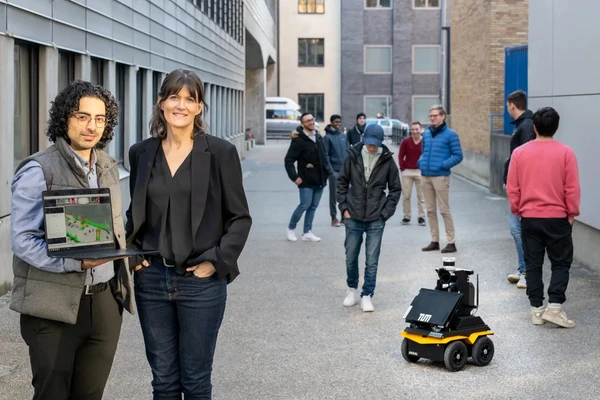
A research team at TUM, led by our PI Angela Schoellig, has developed the mobile robot Jack, which moves safely and efficiently through crowds.

This is made possible by an innovative motion planning algorithm inspired by human behavior. Jack continuously scans its surroundings using a lidar system and updates its trajectory ten times per second, enabling smooth, collision-free movement—even in dynamic environments.

The technology offers promising applications in service robotics and autonomous vehicles, where natural and safe interaction with people is essential.

#research #schoellig
Subscribe to RSS News feed

Related

Link to Tom Sterkenburg Wins Karl-Heinz Hoffmann Prize of the Bavarian Academy of Sciences

08.12.2025

Tom Sterkenburg Wins Karl-Heinz Hoffmann Prize of the Bavarian Academy of Sciences

MCML JRG Leader Tom Sterkenburg receives the Karl-Heinz Hoffmann Prize of the BAdW for his interdisciplinary research.

Link to World’s First Complete 3D Model of All Buildings Released

04.12.2025

World’s First Complete 3D Model of All Buildings Released

Xiaoxiang Zhu’s team releases GlobalBuildingAtlas, a high-res 3D map of 2.75B buildings for advanced urban and climate analysis.

Link to When to Say "I’m Not Sure": Making Language Models More Self-Aware

04.12.2025

When to Say "I’m Not Sure": Making Language Models More Self-Aware

ICLR 2025 research by the groups of David Rügamer, and Bernd Bischl introduces methods to make LLMs more reliable by expressing uncertainty.

Link to

28.11.2025

MCML at NeurIPS 2025

MCML researchers are represented with 47 papers at NeurIPS 2025 (38 Main, and 9 Workshops).

Link to Seeing the Bigger Picture – One Detail at a Time

27.11.2025

Seeing the Bigger Picture – One Detail at a Time

FLAIR, introduced by Zeynep Akata’s group at CVPR 2025, brings fine-grained, text-guided detail recognition to vision-language models.

Back to Top