22.01.2024

The MCML-Exhibition at Deutsches Museum Munich
Our Exhibition Was a Great Success - A Short Recap
The Science Communication Lab at Deutsches Museum hosted our MCML exhibition that attracted thousands of visitors over three weeks.
The exhibition featured interactive exhibits on machine learning, simultaneous localization and mapping (SLAM), and Stable Diffusion, an algorithm that connects images and text. Visitors gained insights into cutting-edge research and enjoyed engaging hands-on experiences.
Around 1.000 visitors per day passed by the Science Communication Lab at Deutsches Museum and saw our exhibition during the last three weeks. It was a lot of fun and we are happy that so many visitors were interested and got a glimpse of our research.
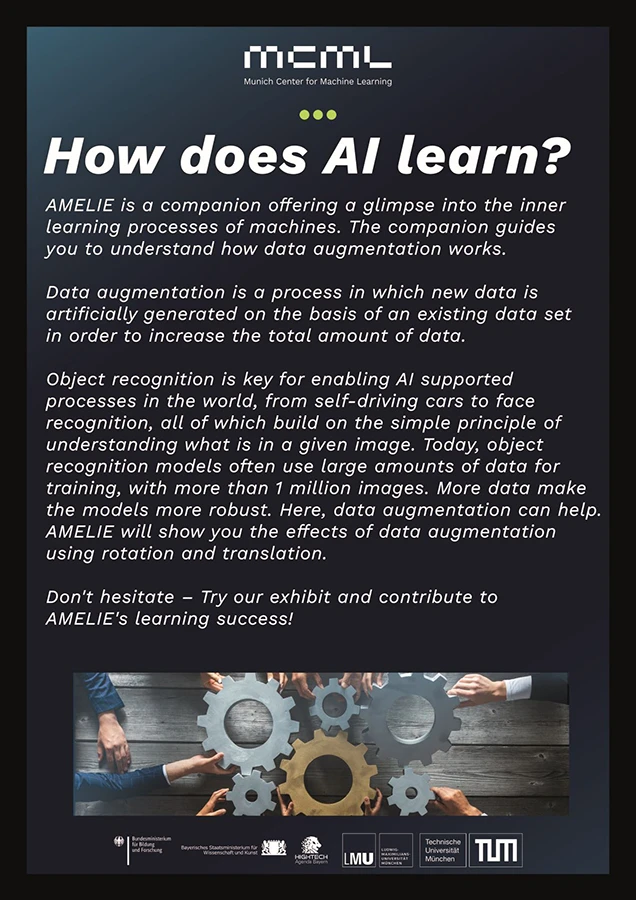
One of the exhibits called AMELIE taught visitors the basics of machine learning in a fun and interactive way. The exhibit was built by the LMU Media Informatics Group of our PI Albrecht Schmidt. You can see a video of the exhibit on YouTube.
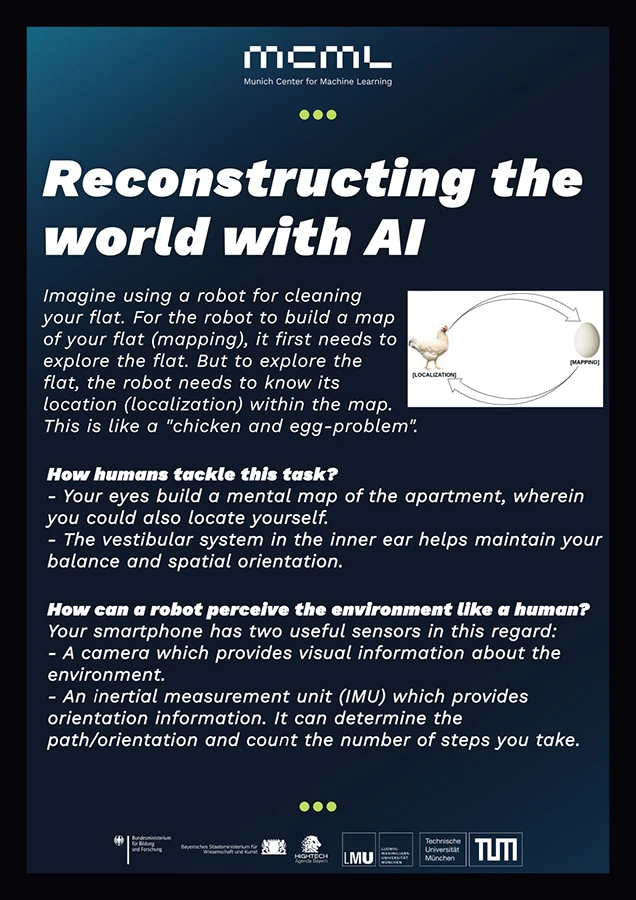
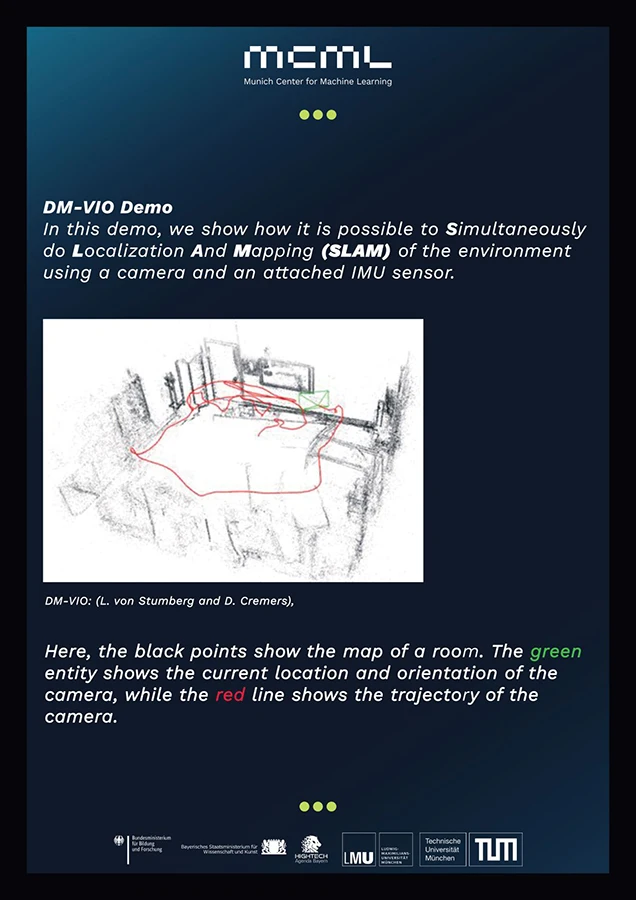
In addition we had a demo showing how it is possible to simultaneously do localization and mapping of the environment using a camera and an attached IMU sensor. The method is called DM-VIO and can be used in self-driving cars, for example. DM-VIO is a project of the TUM Computer Vision Group led by our director Daniel Cremers.
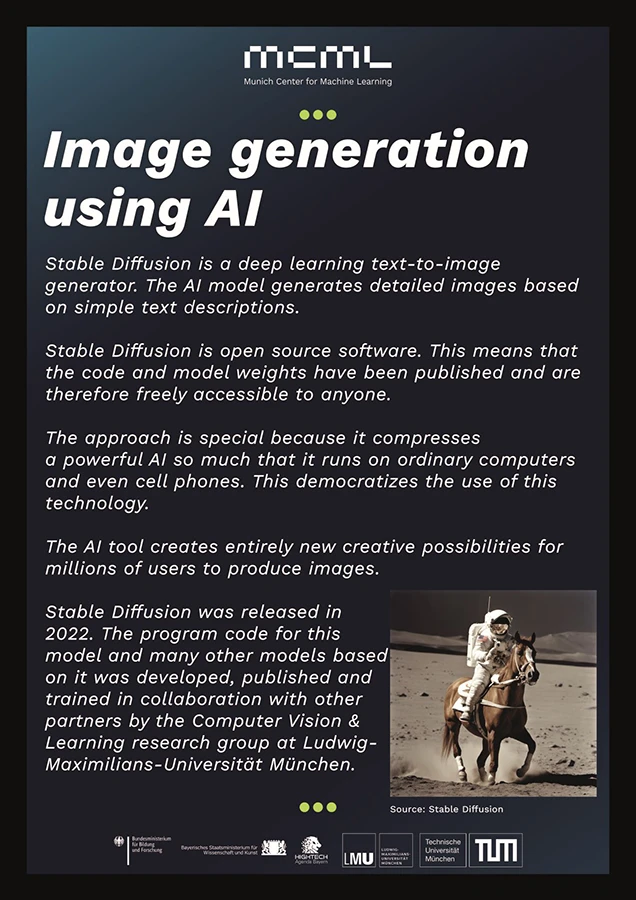
Last but not least, we gave some insights into Stable Diffusion, a deep learning model that generates images from text descriptions. Stable Diffusion is developed by the LMU Computer Vision & Learning Group of our PI Björn Ommer. We explained how Stable Diffusion learns the connection between image and text through a latent diffusion model process.
©MCML
Poster 1: How does AI learn
AMELIE is the name of the museum exhibit that helped visitors understand machine learning principles.
©MCML
Poster 2: Reconstructing the world with AI
We presented DM-VIO, a monocular visual-inertial odometry system based on two novel techniques called delayed marginalization and pose graph bundle adjustment.
©MCML
Poster 3: DM-VIO demo
On this poster visitors saw how the Simultaneous Localization and Mapping unfolds
©MCML
Poster 4: Image generation using AI
Visitors saw how Stable Diffusion works and were able to try it out themselves.
Related
15.10.2026
When Flatter Is Not Always Better
In their ICML 2026 paper, MCML researchers show why the flattest regions found during neural network training are not always the best.

14.10.2026
MCML at the LRZ Open Day 2026
MCML PI Benjamin Lange contributed to the program of the LRZ Open Day in Garching on October 3, 2026.

13.10.2026
Björn Schuller: What Your Voice Reveals About Your Health
MCML PI Björn Schuller explores how AI can analyze the human voice to detect signs of disease and reveal insights into our health.