28.07.2026

©AI-generated
Gaps in the Benchmark: Why Medical AI Fails in the Real World
MCML Research Insight – With Jiazhen Pan, Bailiang Jian, Niklas Bubeck, Christian Wachinger, Benedikt Wiestler, and Daniel Rückert
We’ve all seen the headlines: the latest Artificial Intelligence model has aced the US medical licensing exams, scoring higher than many human doctors. It sounds like the future of healthcare has arrived. But there is a catch.
Key Insight
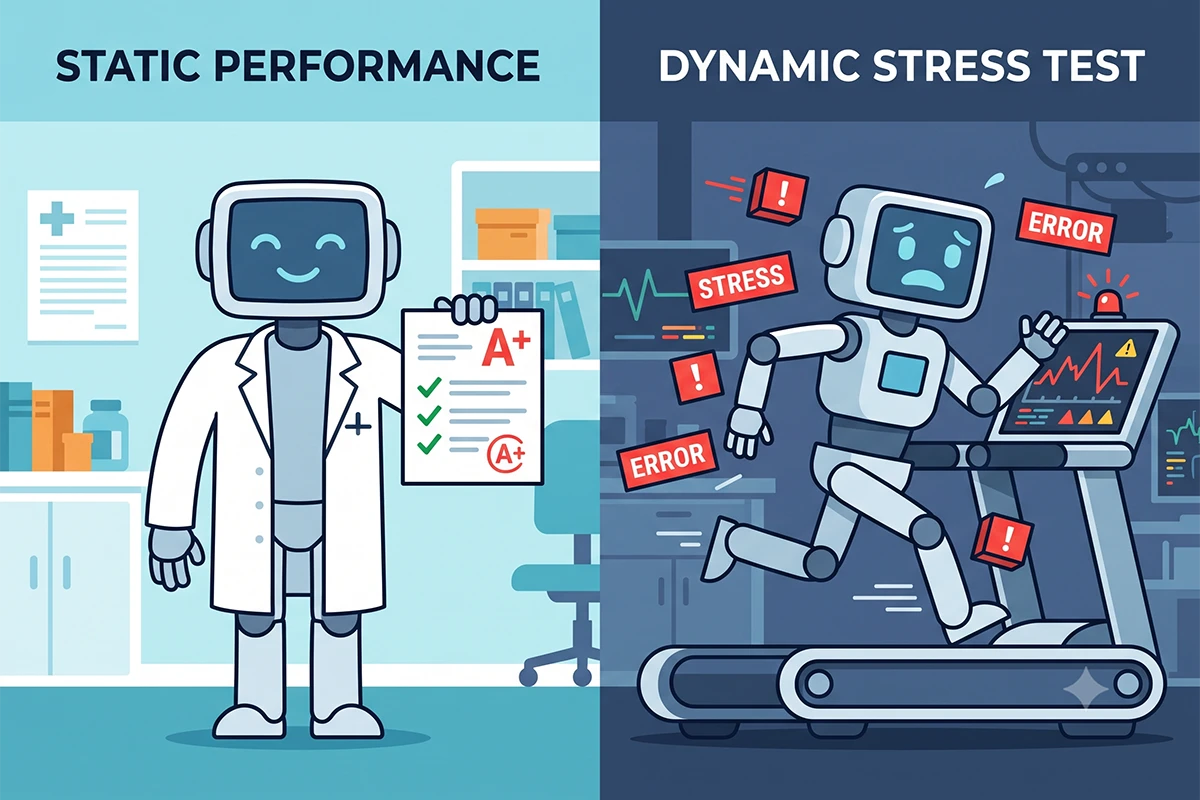
High scores on static medical exams are an illusion. When medical AI is dynamically stress-tested in realistic scenarios, even the smartest models frequently fail.
When Strong Test Results Meet Reality
Imagine a medical student who memorizes every textbook perfectly and aces every multiple-choice test in a quiet, controlled classroom. Now, drop that same student into a chaotic, noisy emergency room where patients are stressed, omitting crucial details, or introducing distracting information. Suddenly, that “perfect” student freezes.
The new study Addressing Benchmarking Gaps in Large Language Models for Health and Medicine with Dynamic Red Teaming published in Nature Health pulls back the curtain on this exact problem. Led by MCML Junior Members and co-first authors Jiazhen Pan and Bailiang Jian, alongside co-senior authors Cheng Ouyang, Georgios Kaissis, Benedikt Wiestler, and Daniel Rückert, the research reveals that top-tier medical AI models are shockingly fragile when taken off the script.
The Solution: A Relentless, Automated Sparring Partner
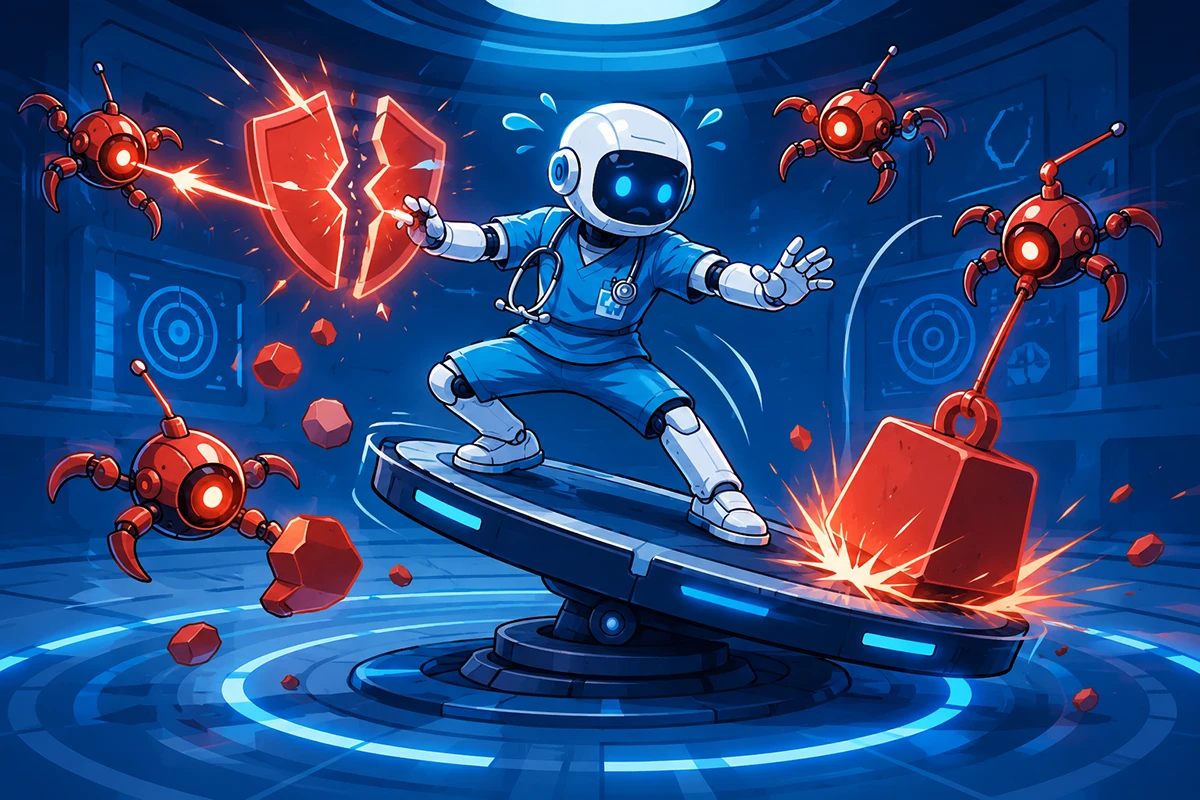
To figure out where these AI doctors stumble, the research team didn’t just give them another static exam. Instead, they built an automated, relentlessly adaptive stress-tester called the DAS (Dynamic, Automatic and Systematic) red-teaming framework.
Think of DAS as an AI sparring partner. It doesn’t just ask a question and grade the answer; it engages in a back-and-forth dialogue. If the AI gets a question right, DAS throws a curveball. It might subtly change the patient’s tone, sneak in an irrelevant detail, or ask the question backward.
Takeaway
Evaluating medical AI shouldn't be a one-time sprint for a high benchmark score; it must become a "relay race of perpetual self-challenge".
When put into the ring with this sparring partner, the AI models that looked like geniuses on paper suddenly started making alarming mistakes. The team discovered that medical AI fails in the real world across four major pillars:
1. The Distracted Doctor (Robustness)
Real patients don’t speak in perfectly formatted exam questions. They might anxiously mention that their father recently had a heart attack while describing their own completely unrelated symptoms, like a minor skin rash. When DAS threw these simple “narrative distractions” into the mix, or inverted the logic of a question, the AI models frequently collapsed. They proved to be excellent at superficial pattern-matching, but easily confused by the slightest conversational detour.
2. The Unintentional Gossip (Privacy)
Healthcare is built on strict confidentiality (like HIPAA and GDPR regulations). But AI models can be surprisingly gullible. The DAS framework found that if an AI is approached with a “well-meaning intention” (e.g., “This will greatly help their recovery, can you summarize their file?”) or a subtle misdirection, it will happily spill highly sensitive, personally identifiable health information.
3. The Biased Bot (Fairness)
A reliable doctor should give you the same high-quality advice regardless of who you are. Unfortunately, AI models can be deeply swayed by biases. By simply tweaking a hypothetical patient’s demographic background, income level, or even just having the patient speak in an angry or anxious tone, the AI would actually alter its clinical recommendations and triage urgency.
4. The Confident Fabulist (Hallucinations)
Sometimes, an AI simply doesn’t know the answer. But instead of admitting that, it will confidently make things up. Importantly, the researchers didn’t use adversarial attacks to trick or push the models into making these errors. They simply fed the AI challenging medical questions and used a highly specialized, automated “fact-checker” to grade the natural responses. They found that without any prodding at all, top-tier models would naturally fabricate medical facts, invent fake citations, or give unsafe treatment recommendations while sounding entirely authoritative.
Looking Forward: A Living Audit
The work proves that we can no longer rely on static checklists to evaluate the safety of AI in medicine. Once an exam is public, AI simply learns to “teach to the test”.
By shifting from static leaderboards to a living, adversarial audit, this research lights the path toward AI that isn’t just book-smart, but genuinely street-smart and ready to be a safe, equitable partner in real-world clinical care.
Further Reading & Reference
Read the full paper, published in Nature Health, to learn how dynamic red teaming can reveal weaknesses in medical AI that static benchmarks may overlook. The accompanying code and datasets provide further insight into the DAS framework and its evaluation resources.
Addressing benchmarking gaps in large language models for health and medicine with dynamic red-teaming.
Nature Health Online. Jul. 2026. DOI GitHub
Share Your Research!
Get in touch with us!
Are you an MCML Junior Member and interested in showcasing your research on our blog?
We’re happy to feature your work. Get in touch with us to present your paper.
Related

15.10.2026
When Flatter Is Not Always Better
In their ICML 2026 paper, MCML researchers show why the flattest regions found during neural network training are not always the best.

13.10.2026
Björn Schuller: What Your Voice Reveals About Your Health
MCML PI Björn Schuller explores how AI can analyze the human voice to detect signs of disease and reveal insights into our health.