15.10.2026

©AI-generated
When Flatter Is Not Always Better
MCML Research Insight – With Leonardo Galli, Wiebke Bartolomaeus, and Holger Rauhut
Imagine hiking through a mountain landscape. A broad, flat valley may look like the easiest route. Yet the flattest path does not necessarily lead where you want to go.
A similar idea appears in the mathematical landscapes used to describe how neural networks learn. New research explores what happens when training reaches exceptionally flat regions and why the flattest destination is not always the best one.
Key Insight
The flattest solution is not necessarily the best one. Reaching an extremely flat region too early can prevent a neural network from learning successfully.
Understanding the Landscape
In their ICML 2026 paper Flatland: The Adventures of Gradient Descent with Large Step Sizes, MCML Junior Members Leonardo Galli and Wiebke Bartolomaeus, MCML PI Holger Rauhut, and collaborators Curtis Fox and Mark Schmidt study how large the steps in neural network training can become while training still converges.
Neural network training can be pictured as movement through a landscape. Each location represents a possible configuration of the network. The height represents the training loss, a measure of how poorly the network currently performs on the training data. Training searches for locations with low loss.
The shape of the surrounding landscape also matters. A narrow valley changes steeply when the network parameters are adjusted. In a broad, flat valley, small changes have much less effect on the loss. This sensitivity is often described in terms of sharpness: flatter regions have lower sharpness. Such regions have attracted considerable attention because earlier research has linked low sharpness with better performance on unseen data, although this relationship remains debated.
Big Question
If flatter regions can be desirable, should training simply aim for the flattest place it can find?
Taking Larger Steps
The paper starts from a practical problem. Neural networks are commonly trained by repeatedly adjusting their parameters to reduce the loss - back to the analogy above, this is the path of the multi-dimensional hiker. The size of each adjustment is controlled by the learning rate. Large steps can make training faster, but steps that are too large can cause training to fail. Finding the largest useful step while keeping training stable has therefore been a longstanding challenge.
The researchers define what constitutes a large step size and develop adaptive methods that select such steps automatically using gradient and function information. This allows training to stay close to the largest step size that still keeps optimization stable from the beginning of training.
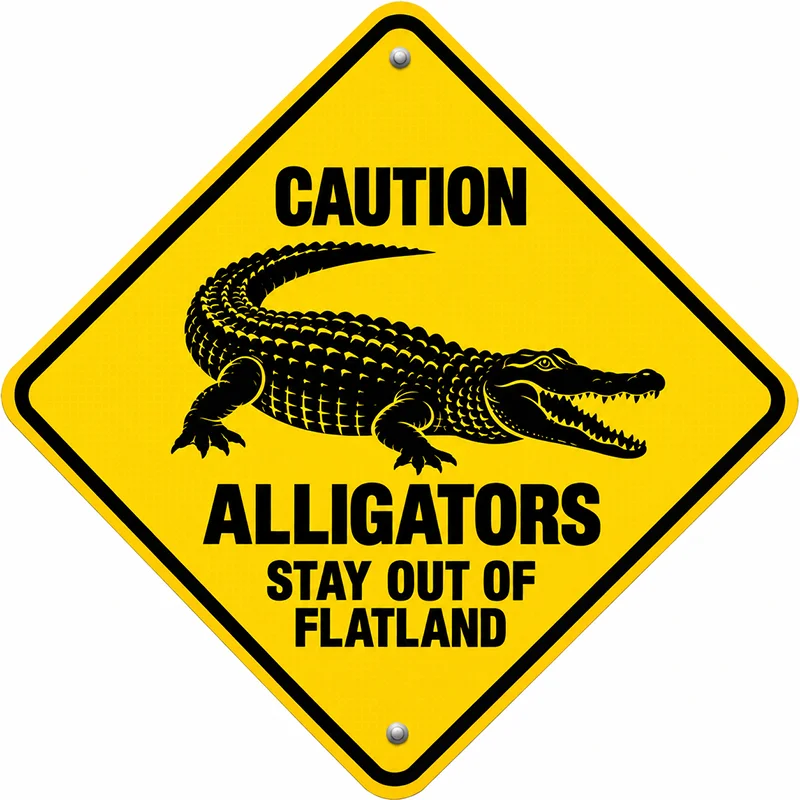
When they push the step size toward this limit, training often moves into regions with the lowest possible sharpness in their setting. The paper refers to this exceptionally flat part of the loss landscape as Flatland.
Core Idea
The new methods allow the researchers to explore what happens when training is pushed toward extremely flat regions of the loss landscape.
When Flatness Becomes a Problem
Some training runs reach these extremely flat regions very early and then make little progress. Their accuracy remains close to random guessing, while the gradients used to update the hidden layers become very small. As a result, these layers can no longer learn useful features. The authors describe these runs as unsuccessfully-flat.
Other runs behave differently. They stay close to the flattest regions without reaching the absolute minimum in sharpness and often achieve low training loss and high test accuracy. The authors refer to these runs as successfully-flat. The researchers then adjust their method to limit the largest steps and show that this can turn unsuccessfully-flat runs into successfully-flat ones.
Key Finding
Maximum flatness can become a trap. Allowing training to move through slightly sharper regions can turn unsuccessful runs into successful ones.
Rethinking Flatness
The findings do not imply that flatness is unimportant. Instead, they show that reaching the lowest possible sharpness is not enough for successful training. In the experiments, networks that enter extremely flat regions too early can stop making meaningful progress, while slightly sharper regions lead to better training outcomes.
The work also leaves open questions. One is why using very large step sizes drives training so efficiently toward globally flat saddle points. The authors also note that further theoretical work is needed to understand convergence in the stochastic setting.
Takeaway
Flatness alone does not determine whether training finds a useful solution. How and when the network reaches a flat region also matters.
Why This Matters
The work provides a systematic way to study neural network training with unusually large steps. It also adds an important qualification to the common intuition that flatter solutions are preferable: a network can reach an extremely flat region and still fail to learn the task.
The results offer a more nuanced way to examine the relationship between learning rates, the geometry of the loss landscape, and successful feature learning, without treating maximum flatness as a goal in itself.
©AI-generated
Further Reading & Reference
Want to see how the researchers define large step sizes and investigate what happens in “Flatland”? The full paper presents the theoretical framework, algorithms, and experiments behind these results.

Flatland: The Adventures of Gradient Descent with Large Step Sizes.
ICML 2026 - 43rd International Conference on Machine Learning. Seoul, South Korea, Jul 06-11, 2026. To be published. Preprint available. URL GitHub
Share Your Research!
Get in touch with us!
Are you an MCML Junior Member and interested in showcasing your research on our blog?
We’re happy to feature your work. Get in touch with us to present your paper.
Related

13.10.2026
Björn Schuller: What Your Voice Reveals About Your Health
MCML PI Björn Schuller explores how AI can analyze the human voice to detect signs of disease and reveal insights into our health.



08.10.2026
Best Paper Award at ASMUS workshop at MICCAI 2026
Ultra-Wide-NeRF, co-authored by MCML PI Nassir Navab and team, won the Best Paper Award at the ASMUS workshop at MICCAI 2026.