27.04.2026
Research Stay at Imperial College London
Lennart Bastian – Funded by the MCML AI X-Change Program
During my research stay at Imperial College London, I had the pleasure of working with the CIRCLE group led by Tolga Birdal in the Department of Computing. Among the various research topics at CIRCLE spanning 3D computer vision and the theory of deep learning, I studied how higher-order topological structures can serve as a unifying structure for modeling complex relational processes, from interactive environments to molecular systems and social networks. This research experience was made possible through the generous support of the MCML AI X-Change program.
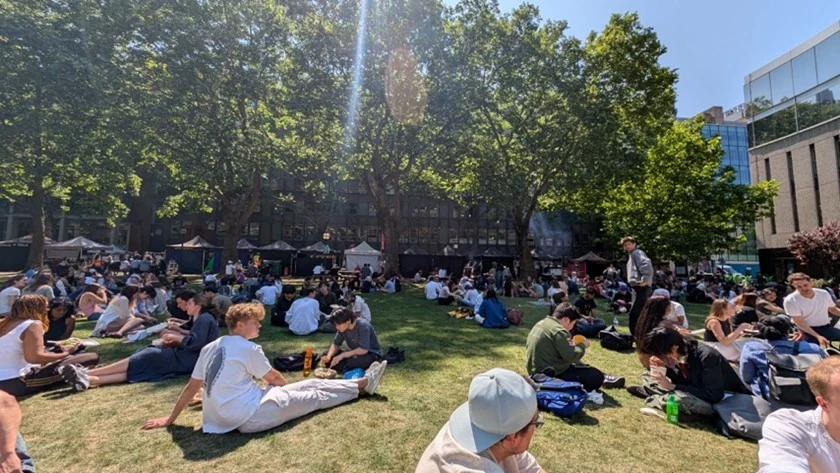
A sunny day at Imperial's South Kensington campus, right in the heart of London's museum district. The weekly farmers market next to Imperial's Queen's Lawn makes a perfect Tuesday lunch break.
The Research Environment at Imperial
The CIRCLE group in the Imperial Department of Computing is a place where applied mathematics meets the engineering and natural sciences. The group is dedicated to developing methods that connect modern geometric and topological deep learning with real-world impact in application domains; questions arising in 3D computer vision and the life sciences often driving new algorithmic ideas.
What makes Imperial’s South Kensington campus special is the proximity to other departments. The Department of Computing shares a floor with the Mathematics and Physics departments, including a common room. Often, while getting coffee you would bump into physicists and mathematicians discussing theoretical topics on the blackboard. Fridays, the Imperial Computing department gathers for Pizza Friday, an opportunity to mingle and exchange ideas.
This physical proximity and initiatives for interaction make interdisciplinary exchange feel natural. In addition to shared spaces, mailing lists for seminars and reading groups are shared between departments, providing the opportunity to expand research horizons. The fresh perspectives are invaluable for spurring new ideas, translating to exciting interdisciplinary works. For instance, conversations with members of the Biochemistry Department opened my eyes to how topological data analysis is being applied to understand molecular processes, domains where the higher-order structures I study have immediate practical relevance.
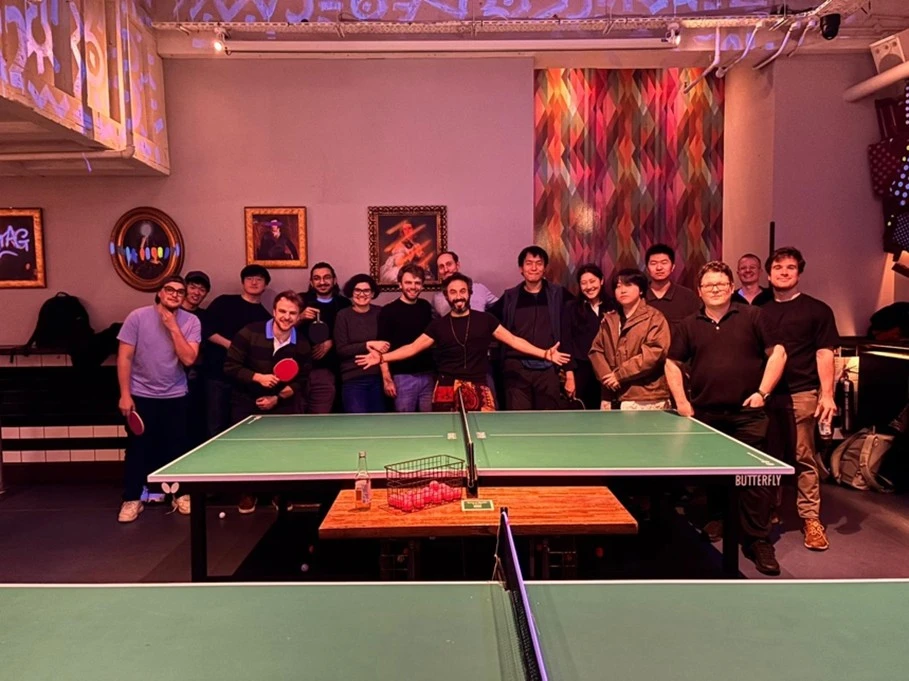
A Circle Group Table Tennis Outing.
Higher-Order Structures for Complex Systems
Complex systems, from proteins and chemical reactions to neural circuits and collaborative working groups, exchange information at multiple levels simultaneously. An emerging school of thought suggests that many such relationships are polyadic, emerging from the simultaneous interaction of multiple components. While graphs have become a universal language for modeling relational data, they are limited to pairwise edges and cannot directly represent these higher-order interactions. The Circle group develops algorithms that navigate such complexities, at both a foundational and a practical deep learning level.
An example from my own PhD research is the surgical operating room. Surgeons, assistants, and other operating staff collectively leverage tools and digital devices to lessen a patient’s ailment. In TopoOR, we argue that this interaction should be modeled and treated collectively, especially in the case of deep learning algorithms. Molecules such as proteins or small inhibitors are another example, where individual atoms exhibit macroscopic behavior through functional groups such as benzene, carboxyl or secondary and tertiary structures, behaving as coordinated units.
Working with Tolga and his group, we explored how structures from algebraic topology, such as simplicial complexes, cell complexes, and hypergraphs, can help us move beyond these pairwise limitations and model group-level interactions directly. We applied this perspective across a range of domains, from surgical scene understanding and multi-view 3D human pose estimation to the design of principled operators that collapse higher-order topological information back down to the node level, an approach inspired by ideas from effective field theories in physics. Working in this environment opened my eyes to several new perspectives on existing and new research, resulting in collaborations that I look forward to continuing.
Life in South Kensington and London
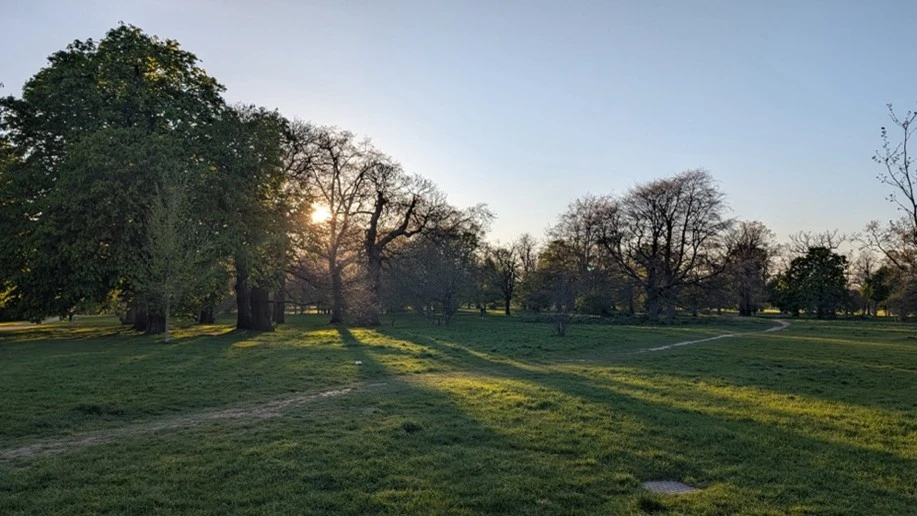
Hyde Park on a spring afternoon; a perfect place to stroll and ponder.
Beyond research, living in South Kensington was an experience of its own. Imperial’s campus sits in the center of South Kensington’s Museum district, more than most universities could ask for. Stepping out of the Department of Computing, you are a five-minute walk from the Victoria and Albert Museum, the Natural History Museum, and the Science Museum. Many of London’s museums are free, making it possible to just stop by for half an hour after work. The Royal Albert Hall, across from the Blackett Physics Laboratory at Imperial also features world class concerts on a regular basis.
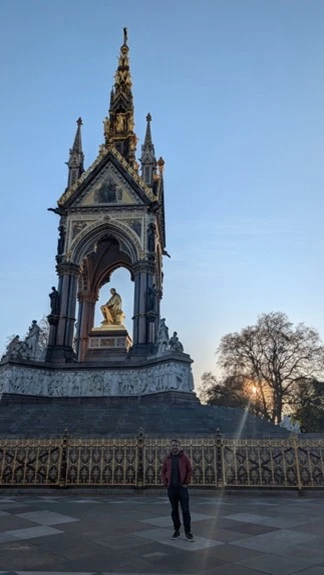
Sunset by the Royal Albert Statue.
A personal highlight was the weekly farmers market held every Tuesday on Imperial’s Queen’s Lawn. Street food from around the world – from spicy birria Tacos, hand pulled noodles, to Uzbek plov, – with crowds of staff and students alike scattering to find their favorite guilty pleasure. It became a ritual for the group. Hyde Park is also literally next door, and a perfect place to clear one’s mind or wind down after work.
London also turned out to be a culinary adventure. The city’s food scene is incredibly diverse, and I made the most of it. A standout was an Indian restaurant in Mayfair set inside a converted church. Borough Market became a regular weekend destination, with its fantastic burgers and endless stalls to explore. Between the street food at the farmers market during the week and places like these on the weekends, I never ran out of new things to try.
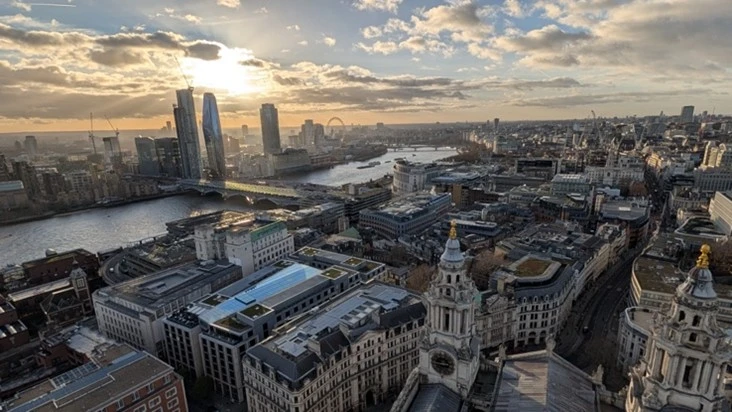
View from St. Paul's Cathedral on a Winter Day.
Beyond South Kensington, London offers more to take-in than possible in a several month stay. On weekends I managed to visit Westminster Abbey, Churchill’s War Rooms, the Tower of London, Tate Britain and Tate Modern, St. Paul’s Cathedral, and countless hidden corners of the city. My overall impression is that London is incredibly diverse, and a place where anyone can carve out a place and community for themselves. Not only that, but the coast is only a train-ride away, with many opportunities to escape the hustle and bustle of the city.
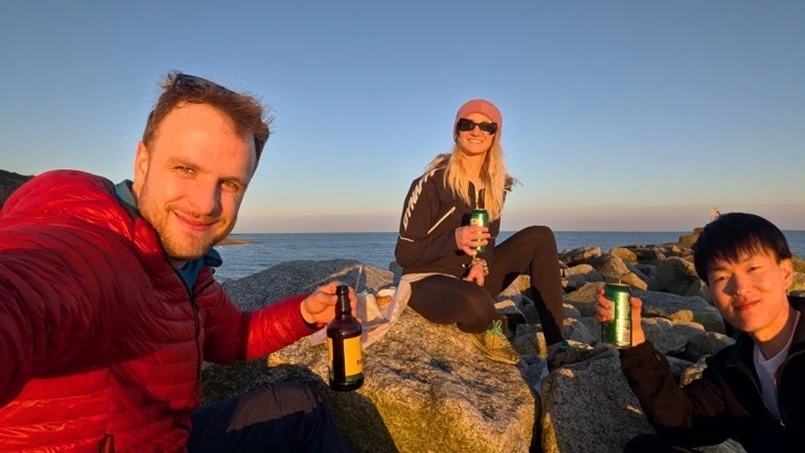
Fish 'n Chips and refreshments after a weekend hike along the coast.
I am deeply grateful to the MCML AI X-Change program for making this entire experience possible. Their support not only enabled the research itself, but also gave me the chance to immerse myself in a new environment, build lasting collaborations, and grow both personally and scientifically. I am equally grateful to Tolga Birdal for hosting me in his group, for the many hours of discussion that shaped my thinking, and for making me feel like a genuine member of the CIRCLE team from day one. A special thanks also to Nassir Navab for his continued mentorship and for encouraging me to pursue this exchange.
Related
15.10.2026
When Flatter Is Not Always Better
In their ICML 2026 paper, MCML researchers show why the flattest regions found during neural network training are not always the best.

13.10.2026
Björn Schuller: What Your Voice Reveals About Your Health
MCML PI Björn Schuller explores how AI can analyze the human voice to detect signs of disease and reveal insights into our health.