22.01.2026
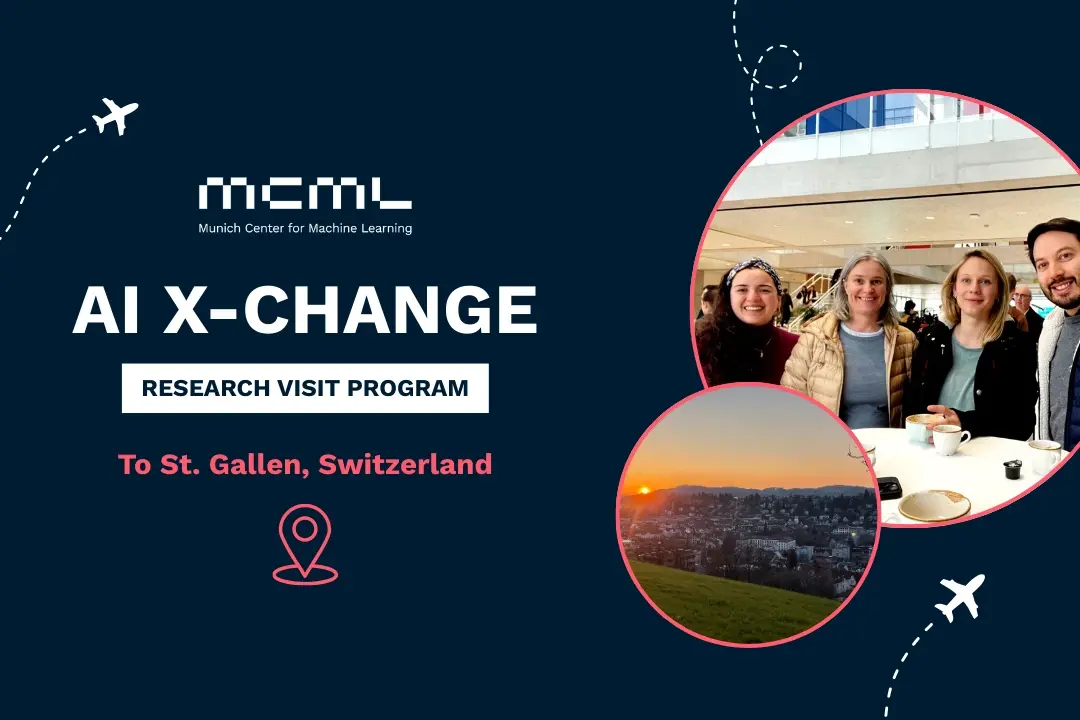
Research Stay at University of St. Gallen
Andrea Maldonado – Funded by the MCML AI X-Change Program
Between Freudenberg – “happiness mountain” – and Rosenberg – “roses mountain”, I had the pleasure to visit the Institute of Computer Science (ICS-HSG) at the University of St. Gallen (HSG) in Switzerland for two weeks, as part of the MCML AI X-Change Program, while being a PhD candidate at LMU Munich and the Munich Center for Machine Learning (MCML). I am deeply grateful to Prof. Dr. Barbara Weber and her Software Systems Programming and Development Chair for hosting me, as well as to the wonderful team at ICS-HSG — including Marco Franceschetti, Lisa Zimmermann, Ronny Seiger, Hagen Völzer, Amine Abbad-Andaloussi, Aaron Kurz, and Thierry Sorg — for the inspiring discussions, warm welcome, and open exchange of ideas.
Research Focus and New Directions
While my research focuses on how process data characteristics impact algorithms robustness and results validity, the primary goal of my stay was to advance joint research on ambiguity generation in IoT-enhanced process mining scenarios. This work sits at the intersection of business process management (BPM), Internet-of-Things (IoT), and event-driven systems. While IoT technologies enable fine-grained monitoring of real-world processes, they also make activity detection particularly challenging, as raw sensor data must be translated into high-level process events. This abstraction step is prone to errors such as missing, spurious, merged, or fragmented activities, which introduce observational ambiguity and compromise downstream analysis. Together with the ICS-HSG team, I worked on systematically characterizing these ambiguity patterns and on developing a novel approach to generate event logs with controlled levels of imperfection. Such realistic yet configurable data is essential for evaluating process mining techniques under conditions that better reflect real IoT deployments. Collaborating with researchers working on adaptive software systems, exposed me to industrial IoT scenarios and healthcare process scenarios, including smart factory sensor-based process executions. This broadened my perspective on how ambiguity-aware data generation can strengthen benchmarking practices and lead to more robust process analysis methods, an insight I look forward to carrying forward into my work.
Academic Environment and Campus Life
Beyond the research itself, the academic environment at HSG was both intellectuallystimulating and personally meaningful. I was struck by the recurring notion of a “red thread” as a guiding element in academic work — not only as a structural principle within papers, but also as a thread connecting people, disciplines, and ideas. This metaphor resonated strongly in St. Gallen, given the city’s textile and embroidery heritage, and it also connected to my own background, as textiles play a central cultural and historical role in Guatemala. This parallel made the local context feel especially vivid and personally relevant. I was also inspired to learn about Elisabeth Rannacher, the first woman to graduate from HSG, whose achievement highlights the important contributions of women in academia and the progress still needed for inclusion today.
Reflection & Outlook
Outside of work, I explored the city and surroundings, visiting the Textile Museum, the world heritage Abbey Library, and hiking through the surrounding mountains. I was particularly struck by the embroidery flowers on display, which not only reflect an admiration-driven abstraction of nature but also serve as a metaphor for how our own understanding—whether of natural patterns or data processes—depends on how ambiguities are handled during abstraction. Just as an embroidered flower condenses complex natural forms into symbolic representations, data abstraction requires careful consideration to ensure meaningful insights. I am very much looking forward to continuing this collaboration, refining our joint ideas, and turning them into concrete research outcomes in the near future.
Related


24.09.2026
Barbara Plank: Building Language Technology for Everyone
MCML PI Barbara Plank explores inclusive language technology and the challenges of building AI that supports linguistic diversity.