01.12.2025
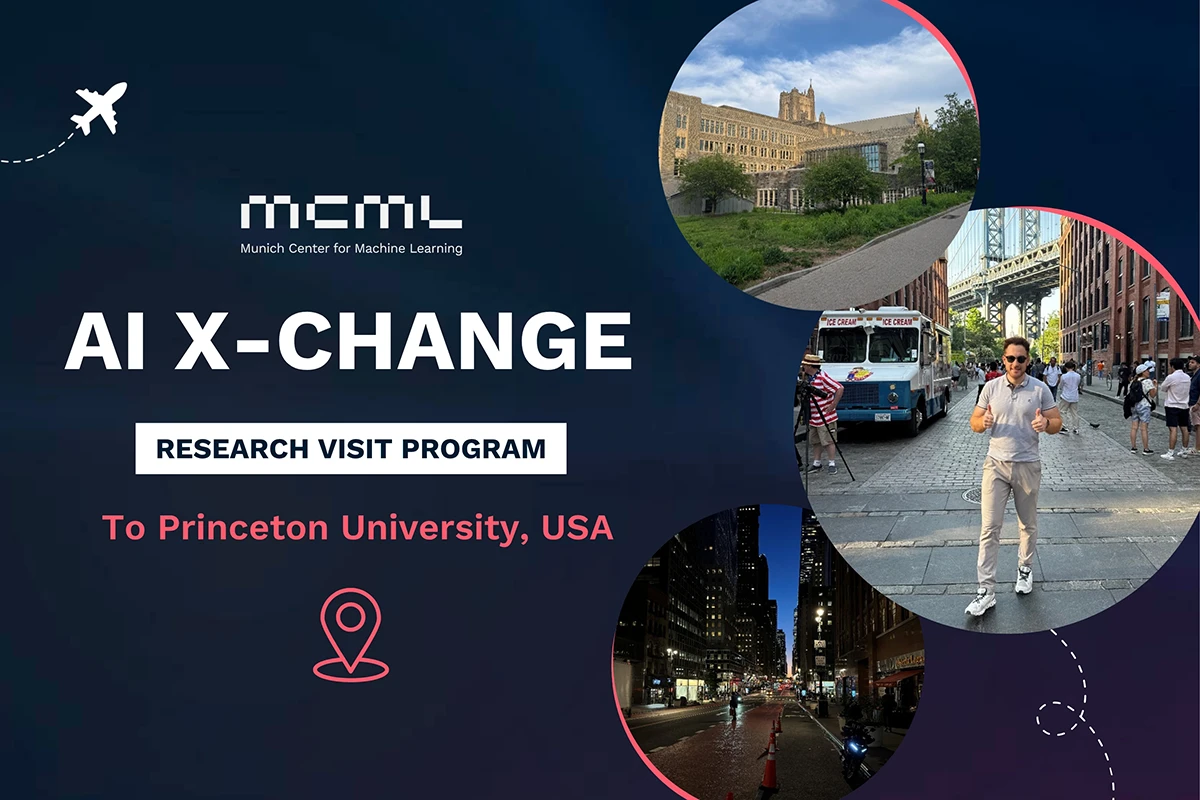
Research Stay at Princeton University
Abdurahman Maarouf – Funded by the MCML AI X-Change Program
From May to July, I spent three exciting months as a visiting researcher at the Computer Science Department of Princeton University, hosted by Prof. Manoel Horta Ribeiro. The visit grew out of a keynote Manoel gave at LMU. After his talk, we discussed potential joint projects at the intersection of causal inference, machine learning, and social computing, which eventually developed into this research stay. I am very grateful to the MCML AI X-Change program, to Manoel for the kind invitation and continuous support, and to everyone at Princeton, LMU, and MCML who made this stay both productive and enjoyable.

Princeton University campus
Research – Combining Causal Inference, Machine Learning, and Social Computing
My PhD research focuses on data-driven decision-making and causal machine learning, with an emphasis on generating actionable insights for business and the social sciences. At Princeton, I worked at the intersection of causal inference, social computing, and machine learning, with a central question: How can we measure the effect of specific platform characteristics on users using observational data?
Making causal claims from observational data is not easy because users do not self-select into platforms at random. To enable a causal interpretation, we aimed to develop a framework with machine learning that first builds comparable groups of users who behave similarly before they are exposed to different platform characteristics. The key idea is that, once these groups are comparable, we can use their pre-exposure trajectories to ask: How would the exposed group have evolved if it had not been exposed to this platform characteristic? So the idea was to combine balancing techniques (propensity-score weighting), stacking of users by adoption timing, and a so-called dynamic difference-in-differences design to estimate the effects of platform characteristics from observational data.

The on-campus gym (with more floors)
The Effect of Short-Form Video Platforms on Mobile Usage
Using the above framework, we then studied how adopting a short-form video platform affects mobile usage. We focused on a period when TikTok’s short-form video was the key feature distinguishing it from Instagram and Facebook, and compared users who adopt TikTok to similar users who instead adopt Instagram/Facebook. Applying our framework to a representative U.S. panel, we found that adopting a short-form video platform increases total mobile usage by up to 17% (around 28 extra minutes per day) and reduces the average time away from the mobile by about 20% (29 fewer minutes per day). Notably, effects were stronger for users who previously used their phones less and were concentrated in daytime rather than at night.
I am very thankful that the successful collaboration lead to a completed project within just a few months (preprint: here).

Myself in front of the Brooklyn bridge
Life on and Off Campus
Life at Princeton was a pretty ideal mix of brain and fun. The days were packed with working on the research project, meetings, department seminars, and social activities in the evening. A cool part was that I shared an office with researchers in HCI, social computing, and reinforcement learning, which meant regular spontaneous conversations about new ideas and how to use causal inference in real-world systems. The campus itself was great: good food (which was often free :D), solid libraries, plenty of social stuff. One personal highlight was the huge gym, which I used regularly and even got to lift with my hosting professor there. On the weekends, things shifted from orange-and-black to city-lights: New York is only about 90 minutes from Princeton, so I went there every second weekend, with quick trips to Philadelphia, Washington, D.C., and Boston on top.
All in all, I’m super thankful for the research program, the people I met, the weekend escapes, and the chance to call Princeton (and half the East Coast) home for a few months!
Related
02.04.2026
How AI Avatars Shape Perceived Fairness
Accepted at CHI 2026, this study shows how the race and gender of AI interview avatars shape perceptions of fairness and bias in automated hiring.
19.03.2026
Teaching Models to Say ‘I’m Not Sure’
Unified diffusion theory for images and text, bridging continuous and discrete models in one clear framework for generative AI.
05.03.2026
Foundations of Diffusion: One Map for Images and Text
Unified diffusion theory for images and text, bridging continuous and discrete models in one clear framework for generative AI.