20.11.2025
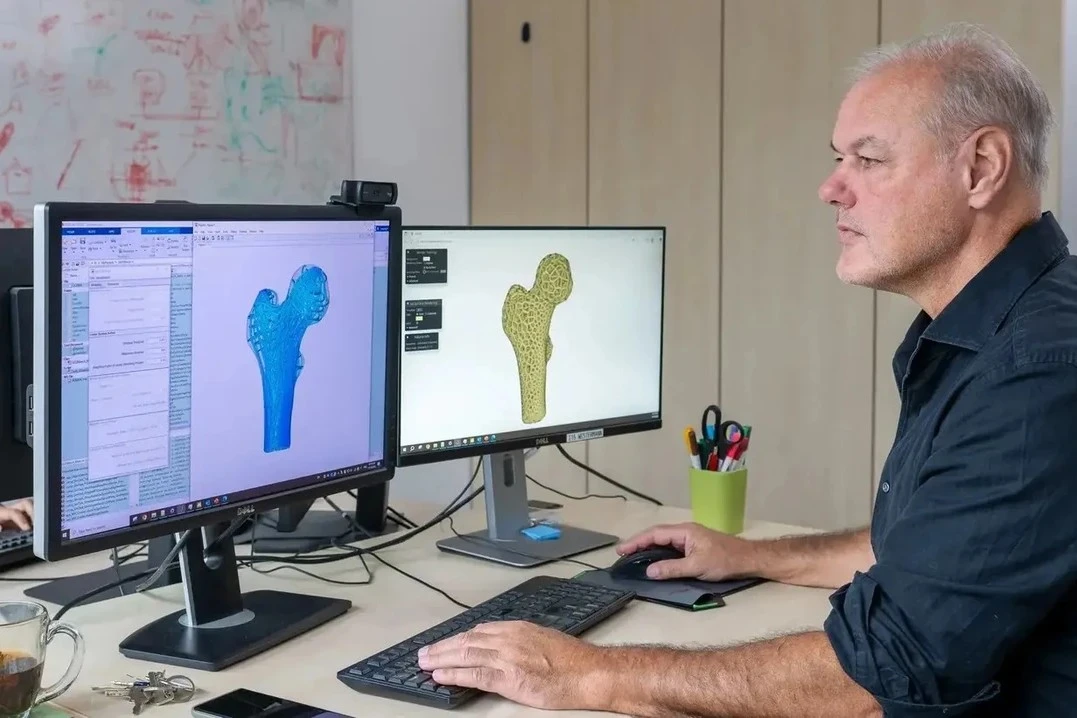
©Andreas Heddergott / TUM
Uniform Reference System for Lightweight Construction Methods
Rüdiger Westermann Develops Benchmark for Lightweight Design
How can components be designed for an optimal balance of minimal weight and maximum robustness? This is a challenge faced by many industries, from medical device manufacturing to the automotive and aeronautics sectors. MCML PI Rüdiger Westermann and his team have developed a reference system that permits direct comparisons and evaluations of many different lightweight construction methods.
Lightweight components are generally designed with computer-based methods before being manufactured. There are various common methodologies. Because they use different physical and mathematical descriptions, however, direct comparisons are difficult. Moreover, the highly complex computation methods limit them to low spatial resolutions. With their Stress-Guided Lightweight 3D Designs (SGLDBench) benchmark, the researchers have succeeded in overcoming these serious obstacles.
SGLDBench Standardizes Lightweight Design Methods
SGLDBench permits six reference strategies such as classical topology optimization, porous infill structures or lattice-based layouts to be applied to arbitrary components with user-defined boundary conditions and compared using 3D simulations. It incorporates such parameters as stiffness-to-weight, stress fields and deformability as well as information on how the component or structure is connected to or positioned in its surroundings. This enables users to create designs with different resolutions and material use while evaluating the mechanical and geometric characteristics.
The new benchmark has potential applications in many areas: for example, it enables testing of various design variants for hip implants followed by customized manufacturing. In the automotive and aerospace industries, the benchmark will also help to make parts even leaner. In those areas, weight savings lead to improved energy efficiency. At the same time, the structures must be designed to meet stringent safety standards in their ability to withstand shocks and vibrations.
Benchmark Allows More Than 100 Million Simulation Elements
“With SGLDBench we have created a transparent benchmark for lightweight design,” says MCML PI Rüdiger Westermann, Professor for Computer Graphics and Visualization at the TUM School of Computation, Information and Technology. “That will not only help researchers with the classification of methods, but will also give companies a tool for reaching well-founded decisions in product development.” At present, SGLDBench can perform simulations with more than 100 million elements on an affordable desktop computer in much faster times than commercial products.”
Among the methods making this possible, the researchers used new approaches in particular for the efficient solution of large systems of equations for stress simulations and optimized them for conventional computer architectures.
Related


23.10.2026
MCML at EMNLP 2026
MCML researchers are represented with 33 papers at EMNLP 2026 (21 Main, 11 Findings, and 1 Workshop).

15.10.2026
When Flatter Is Not Always Better
In their ICML 2026 paper, MCML researchers show why the flattest regions found during neural network training are not always the best.