19.08.2025
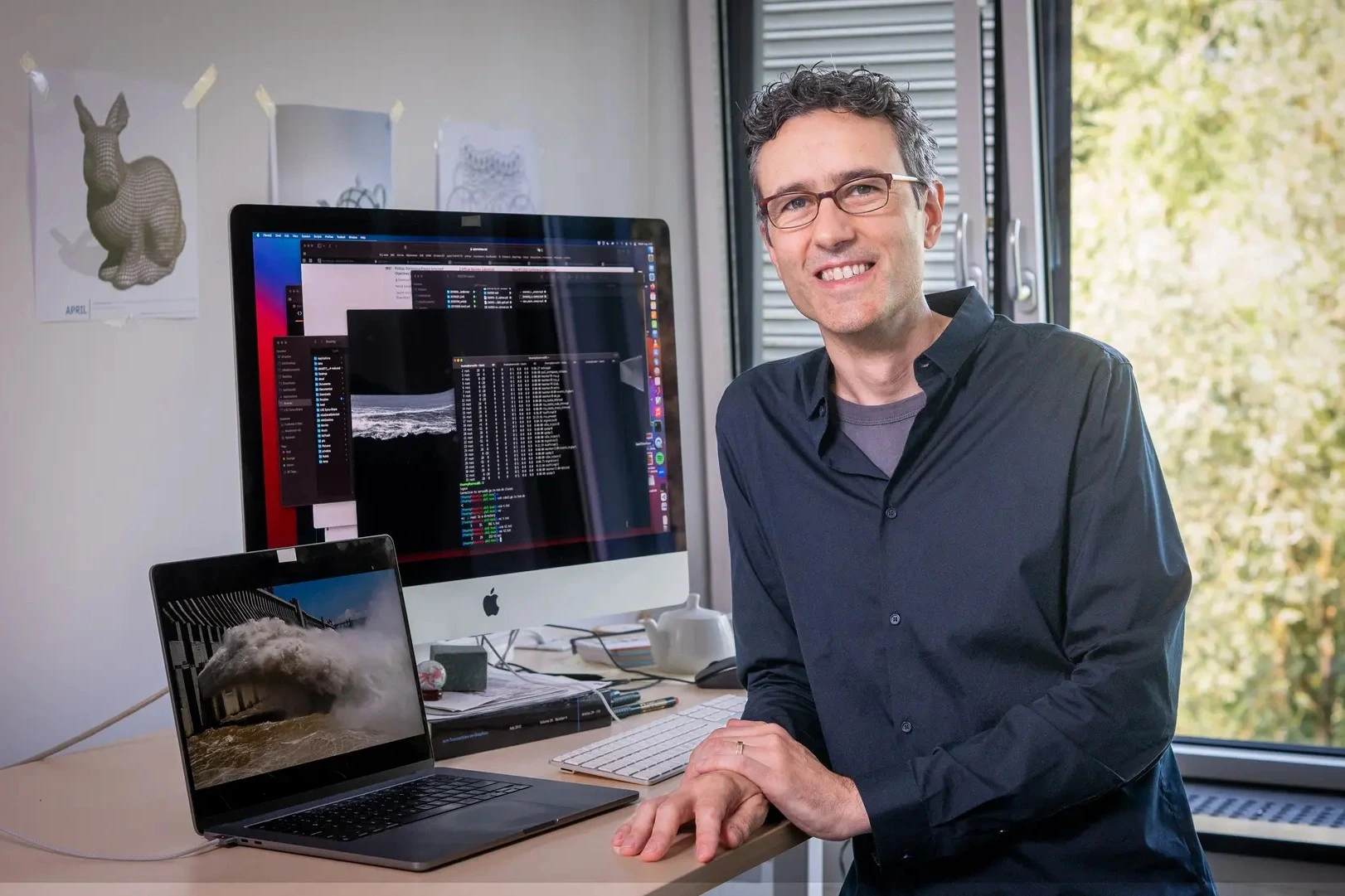
©Andreas Heddergott / TUM
New Method Facilitates Realistic Simulation of Fluids
Nils Thuerey and His Team Simulate Wave Movements
Storm surges or collapsing dams: authentic simulations of water flows are not only important for special effects in disaster movies, but could also help to protect coastal regions. For more realistic simulations of fluid motions, MCML PI Nils Thuerey, Professor of Physics-based Simulation at TUM, and his team have developed a new method. Along with water, the method also takes into account the interaction with air. The approach is so efficient that calculations of complex wave motions can even be carried out with standard computers.
A wave breaks on the shore, sending up splashes of water and spray and creating eddies in the surrounding air. However, the digital simulation of this everyday natural occurrence is anything but routine. Previous computer graphic methods focused on the water and neglected the interaction with air. Effects such as spray and foam were represented in simplified form, resulting in visible differences between the simulation and reality.
«We have now succeeded in developing a process that incorporates both phases – water and air – equally. Through this two-phase simulation, as we call it, we can also represent such details as aerosols and eddies in the air much more realistically than in past approaches.»
Nils Thuerey
MCML PI
Minimizing Computing Power While Maximizing Precision
In the study, the boundary between air and water is not reconstructed as a fixed surface, but rather as a continuous transition zone. To do so, the researchers apply a hybrid method incorporating a grid and particle simulation. While the grid simulation calculates physical properties such as velocity and pressure, the particle simulation captures the motion and distribution of the fluid. The simulation dynamically adapts to the complexity of the wave motion and refines itself in areas where the most motion is occurring – for example in the spray zone of a breaking wave. At the same time, the system conserves resources in less active areas.
“By focusing our simulation only on certain areas, we save a lot of computing power and can also efficiently compute highly complex wave motions with billions of particles and grid cells on a standard system,” says Bernhard Braun, first author and doctoral candidate at the Professorship of Physics-based Simulation. “At the same time, this approach has enabled us to simplify the calculation of the pressure difference between air and water. This has always been a big challenge in the two-phase simulation.”
Applications Also Possible in Coastal Protection
The simulation of fluids is not only important in big-budget movies. It also has potential applications in such fields as oceanography. Through the simulation of high waves or even dam failures, it could help to provide better protection of coastal regions against floods or other extreme weather events.
©TUM
Related

15.10.2026
When Flatter Is Not Always Better
In their ICML 2026 paper, MCML researchers show why the flattest regions found during neural network training are not always the best.

13.10.2026
Björn Schuller: What Your Voice Reveals About Your Health
MCML PI Björn Schuller explores how AI can analyze the human voice to detect signs of disease and reveal insights into our health.