07.07.2025
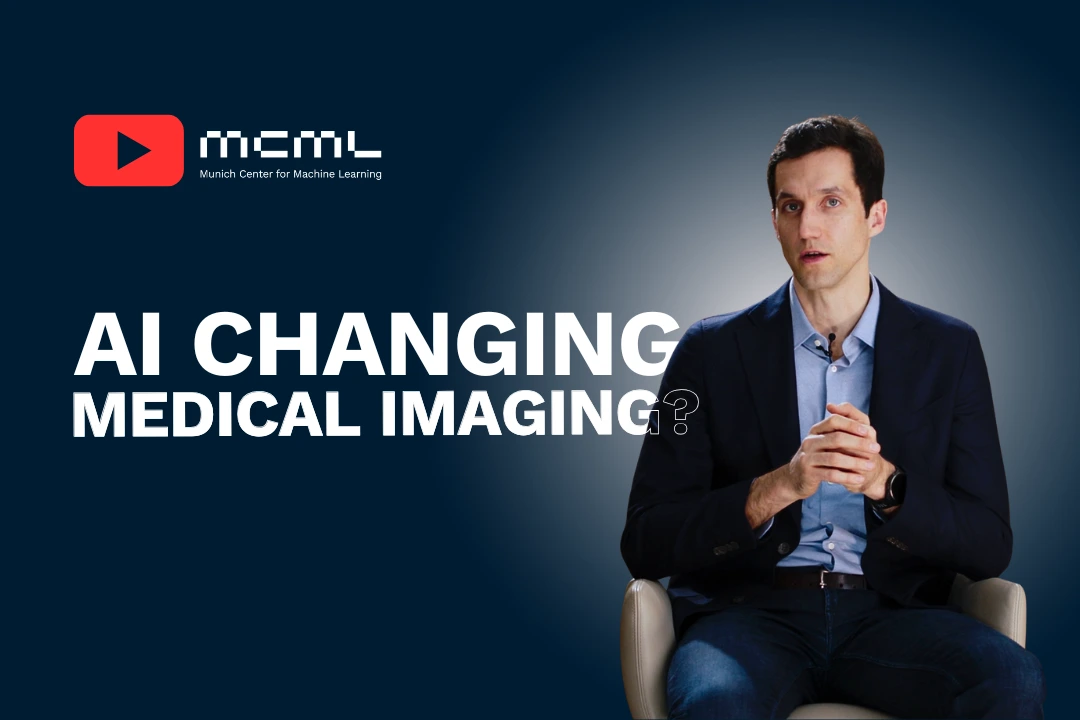
How Neural Networks Are Changing Medical Imaging – With Reinhard Heckel
Research Film
Clear imaging is essential for accurate diagnosis — but when it comes to the heart, motion makes it one of the most difficult organs to capture in high resolution. Traditional reconstruction methods often struggle to deliver the detail clinicians need.
«Deep neural networks can improve the clarity and diagnostic value by giving much sharper and higher resolution images from measurements where classical methods just don’t do as well.»
Reinhard Heckel
MCML PI
Reinhard Heckel, Professor of Machine Learning at TUM and MCML PI, is using deep neural networks to change that. His team is developing methods that reconstruct sharper, more detailed images from limited or noisy measurements — even when the subject is moving.
«The data is really what makes the difference between a well-performing method that is robust and reliable, and a method that is just going to work on a handful of patients.»
Reinhard Heckel
MCML PI
A key focus of his research is data: how to source it, how to ensure it’s diverse, and how to train robust models that generalize across patient populations.
This work is paving the way for more accurate imaging tools that can help detect pathologies that might otherwise go unnoticed.
This video is part of our MCML spotlight series on researchers driving real-world impact with AI.
©MCML
The film was produced and edited by Nicole Huminski and Nikolai Huber.
Related
15.10.2026
When Flatter Is Not Always Better
In their ICML 2026 paper, MCML researchers show why the flattest regions found during neural network training are not always the best.

13.10.2026
Björn Schuller: What Your Voice Reveals About Your Health
MCML PI Björn Schuller explores how AI can analyze the human voice to detect signs of disease and reveal insights into our health.