Home  | News

07.04.2025

Teaser image to IVADO Visits MCML

IVADO Visits MCML

Exploring Collaboration, Global Research Opportunities, and the New AI X-Change Program

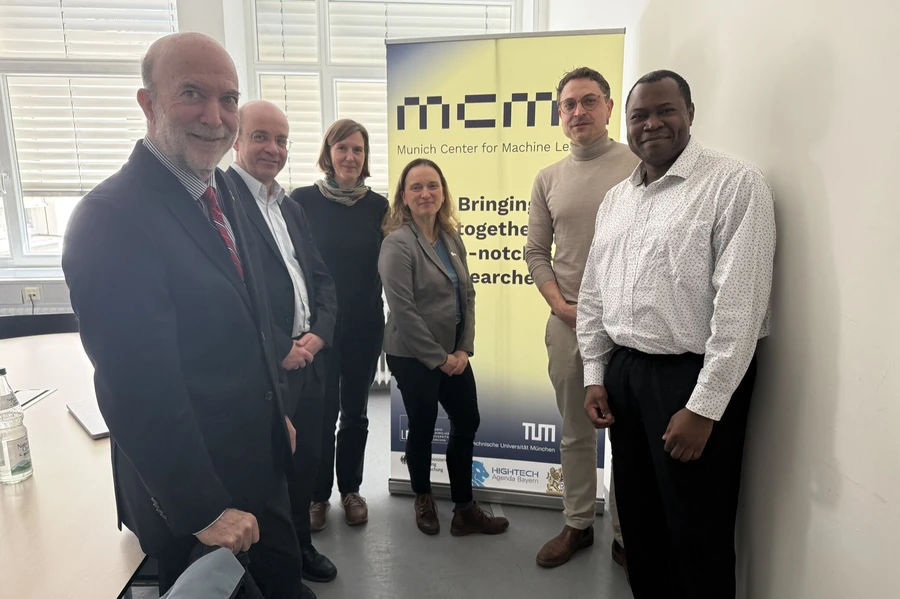
The MCML was honored by the visit of Luc Vinet, Foutse Khomh, and Josée Savard from IVADO, Montreal. IVADO is a research consortium led by Université de Montréal to advance robust, reasoning, and responsible AI.

We talked about transatlantic scientific cooperation between Germany and Canada and also about the importance of research stays for young scientists. The MCML presented its newly established AI X-Change program, in which we offer our junior members support for research stays abroad.

#community #research
Subscribe to RSS News feed

Related

Link to Needle in a Haystack: Finding Exact Moments in Long Videos

05.02.2026

Needle in a Haystack: Finding Exact Moments in Long Videos

ECCV 2024 research introduces RGNet, an AI model that finds exact moments in long videos using unified retrieval and grounding.

Read more
Link to Benjamin Busam Leads Design of Bavarian Earth Observation Satellite Network “CuBy”

04.02.2026

Benjamin Busam Leads Design of Bavarian Earth Observation Satellite Network “CuBy”

Benjamin Busam leads the scientific design of the “CuBy” satellite network, delivering AI-ready Earth observation data for Bavaria.

Read more
Link to Cracks in the foundations of cosmology

30.01.2026

Cracks in the Foundations of Cosmology

Daniel Grün examines cosmological tensions that challenge the Standard Model and may point toward new physics.

Read more
Link to How Machines Can Discover Hidden Rules Without Supervision

29.01.2026

How Machines Can Discover Hidden Rules Without Supervision

ICLR 2025 research shows how self-supervised learning uncovers hidden system dynamics from unlabeled, high-dimensional data.

Read more
Link to Matthias Nießner Co-Founds AI Startup Synthesia

28.01.2026

Matthias Nießner Co-Founds AI Startup Synthesia

Julien Gagneur comments on DeepMind’s AlphaGenome, highlighting its precision and remaining challenges in genome prediction.

Read more
Back to Top