25.02.2024
ELLIS Workshop: Semantic, Symbolic and Interpretable Machine Learning
Organized by Volker Tresp
MCML PI Volker Tresp organized an ELLIS Workshop together with Kristian Kersting (TU Darmstadt) & Paolo Frasconi (Università di Firenze).
The workshop concerned machine learning approaches which operate at the human abstraction level, where the world is described by entities, concepts, and their mutual relationships. Among other topics, multi-relational learning, learning with (temporal) knowledge graphs, and the extraction of statistical and logical regularities from data were covered. Methods included embedding approaches, graph neural networks, scene graph analysis, neuro-symbolic programming, and inductive logic programming.
The workshop brought together like-minded researchers who had fruitful interactions.
Related

01.07.2026
MCML at ACL 2026
MCML researchers are represented with 36 papers at ACL 2026 (20 Main, 15 Findings, and 1 Workshop).
30.06.2026
All AI? an Elephant With Three Legs and an Ice Cream Stand With Enough Ice Cream for Everyone
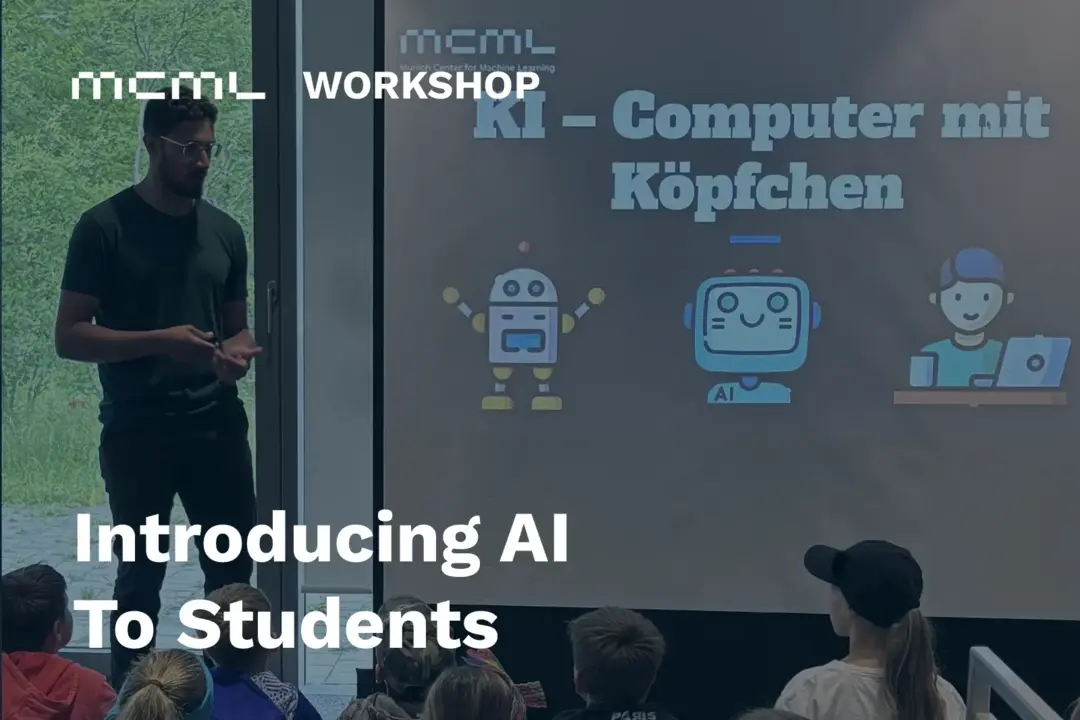
In mid-June, four AI workshops took place at the Eching Municipal Library for all fourth-grade pupils of the primary school on Danziger Straße.
30.06.2026
MCML Junior Members Featured in BR Abendschau
LMU researchers are putting different large language models head-to-head to find out which one delivers the most accurate predictions.