03.07.2026
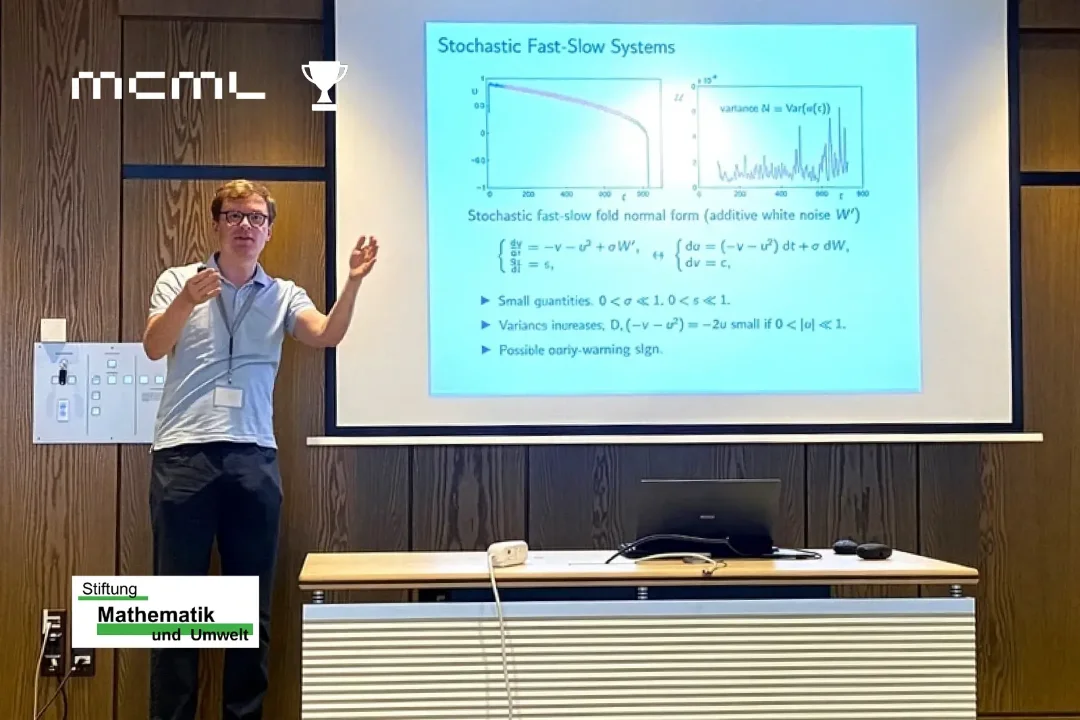
©Thomas Wick / Leibniz University Hannover
Christian Kühn Receives Award From the Mathematics and Environment Foundation
His Work Provides Key Approaches to the Early Detection of Climate Risks and Strengthens Interdisciplinary Environmental Research
MCML PI Christian Kühn, Professor of Multiscale and Stochastic Dynamics at the TUM School of Computation, Information and Technology of the Technical University of Munich, received the award on June 12, 2026, as part of the “Mathematics and Environment” workshop at Leibniz University Hannover. With this award, the foundation recognizes scientific work that successfully applies mathematical methods to solve pressing environmental challenges.
Mathematics as a Key to Addressing Global Environmental Crises
Melting glaciers, extreme weather events and rising sea levels: the impacts of climate change are immense. To strengthen the role of mathematics in analyzing and addressing these environmental challenges, Professor Ernst P. Stephan and his wife Karin Sabine Stephan have established the “Mathematics and Environment” Foundation.
The foundation aims to highlight the potential of mathematical research in solving environmental problems and to promote interdisciplinary collaboration. The Ernst P. Stephan Award, named after the foundation’s founder and emeritus professor of mathematics at Leibniz University Hannover, is endowed with up to 5,000 euros and was awarded for the first time this year.
Fundamental Contributions to Tipping Points and Early-Warning Signals
The award for Christian Kühn is based on his outstanding contributions to the mathematical theory of critical transitions (tipping points) and their associated early-warning signals. Critical transitions describe abrupt changes in complex systems – for example, the tipping of climate systems or the collapse of ecosystems.
In his groundbreaking research paper “A Mathematical Framework for Critical Transitions” (published in two parts, in 2011 in Physica D and in 2013 in the Journal of Nonlinear Science), he developed, for the first time, a clear theoretical framework for critical transitions by establishing a systematic classification of transitions in stochastic multiscale systems. In doing so, he demonstrated how statistical early-warning signals can be identified on a sound mathematical basis.
In the years that followed, he significantly extended this theory to real-world applications, including networked, spatial and stochastic systems. This made it possible to identify early-warning signals even in complex settings such as climate, ecosystem or epidemiological models.
Direct Practical Relevance and Interdisciplinary Impact
It is particularly noteworthy that Kühn has not only established theoretical foundations but has also consistently applied his results to models with direct environmental relevance. His work has made a significant contribution to translating mathematical early-warning indicators into practical applications in environmental research and has attracted global attention. The high citation rate and major EU-wide follow-up projects based on his findings – such as CriticalEarth and ClimTip – underscore the broad impact of his research.
Related

15.10.2026
When Flatter Is Not Always Better
In their ICML 2026 paper, MCML researchers show why the flattest regions found during neural network training are not always the best.

13.10.2026
Björn Schuller: What Your Voice Reveals About Your Health
MCML PI Björn Schuller explores how AI can analyze the human voice to detect signs of disease and reveal insights into our health.