12.08.2025

Tracking Actions in Space and Time: ICCV 2025 Challenge & Workshop
MCML Research Insight - With Tanveer Hannan, Mark Weber, and Thomas Seidl
Tracking actions, not just objects: The Spatiotemporal Action Grounding Challenge and Workshop at ICCV 2025 focusses on detecting and localizing actions both in space and time within complex, real-world videos.
Unlike standard action recognition, this task requires identifying when and where an action occurs, pushing models to handle long, diverse, and occlusion-heavy video content. Applications range from sports analytics to autonomous systems and large-scale video search.
The worksop is organized by MCML Junior Members Tanveer Hannan and Mark Weber, MCML Director Thomas Seidl and collaborators.
«We believe this challenge will bring the community together to push the boundaries of spatiotemporal video understanding.»
Tanveer Hannan
MCML Junior Member, Co-Organizer
Challenge Overview
The challenge provides:
- A large-scale dataset with dense spatiotemporal annotations.
- Standardized evaluation for fair comparison.
- Baseline models & open-source code for quick experimentation.
The Evaluation Server is open until September 19, 2025, allowing teams to submit results and receive immediate feedback.
Check Out an Example Video From the Dataset
It features dense spatiotemporal annotations, with user queries paired with corresponding object bounding boxes in every frame. At the top, you’ll see the current frame number and a visual summary of the number of queries (shown as boxes). At the bottom, the specific textual user query is displayed.
«This is an exciting opportunity to connect research and real-world applications.»
Rajat Koner
Amazon, MCML Alumni, Co-Organizer
Workshop Highlights
The challenge will conclude at our ICCV 2025 Workshop in Hawaii, featuring:
- Invited talks from leading video understanding researchers.
- Panel discussions on future directions.
- Top team presentations detailing innovative solutions.
Full details, including the evaluation package, dataset description, and baseline code, are available on the Workshop Website.
«We want to see methods that not only achieve high accuracy but also work in real-world scenarios.»
Organizers
Why Now?
The explosion of online video makes robust spatiotemporal grounding essential. The complexity of actions, camera changes, and temporal reasoning demands methods that are accurate, generalizable, and efficient. Advances in Vision-Language Models (VLMs) and multimodal learning open new possibilities, and this challenge aims to accelerate progress.
Get Involved
We invite the computer vision community to join us.
Participate in the Challenge
Explore Resources
Meet Us at ICCV 2025
We look forward to your submissions and discussions at ICCV 2025 in Hawaii.
Share Your Research!
Get in touch with us!
Are you an MCML Junior Member and interested in showcasing your research on our blog?
We’re happy to feature your work—get in touch with us to present your paper.
Related
24.03.2026
Cybersecurity: “Even Smart Light Bulbs Harbor Risks”
Interview with computer science expert Johannes Kinder on digital security in everyday life.

24.03.2026
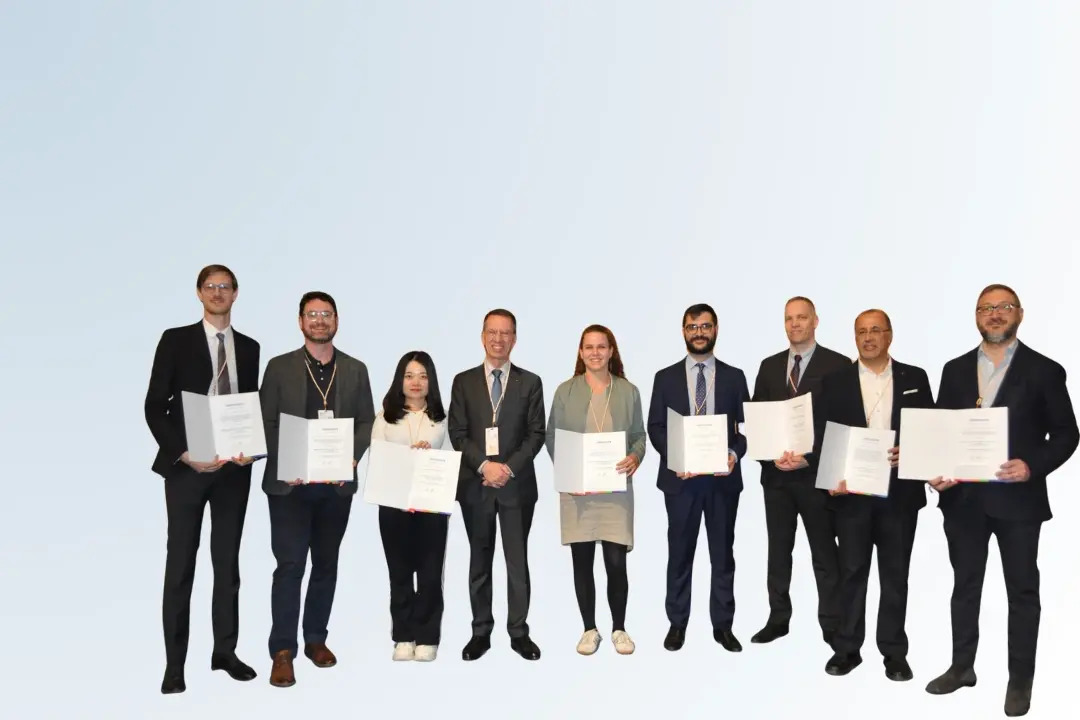
MCML Members Win Most Cited Article Award at ECR 2026
MCML researchers win top citation award for ChatGPT radiology study, highlighting benefits and risks in patient communication.
20.03.2026
MCML Reaches H-Index of 100
MCML reaches an h-index of 100, marking a milestone achieved through years of collaboration with LMU Munich, TUM, and research partners worldwide.