24.01.2025
©Astrid Eckert / TUM
How to Analyze Millions of Individual Cells
TUM News
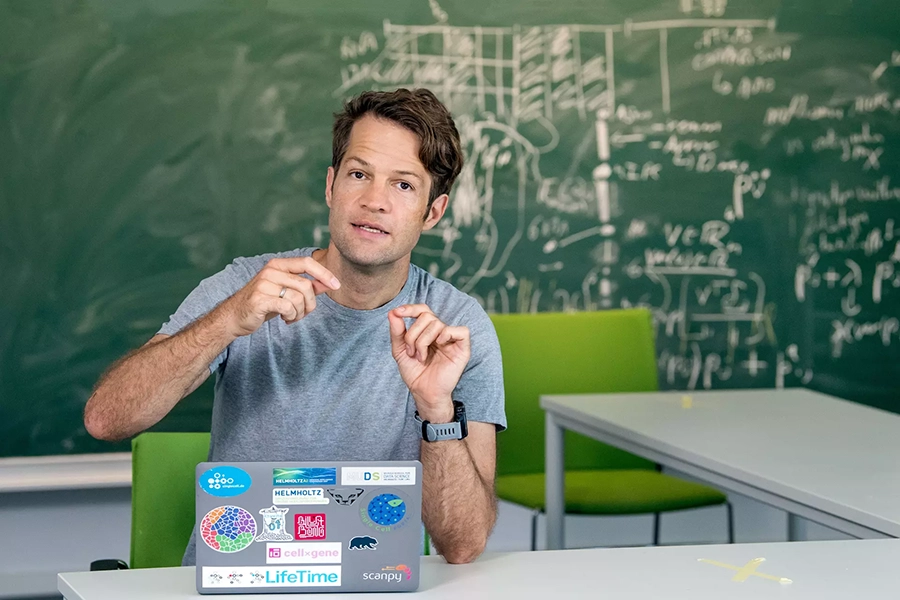
Researchers from the Technical University of Munich (TUM) and Helmholtz Munich have tested self-supervised learning as a promising approach for analysing over 20 million individual cells. MCML PI Fabian Theis holds the Chair of Mathematical Modelling of Biological Systems at TUM. Together with his team, he has investigated whether self-supervised learning is better suited to analysing large amounts of data than other methods.
Given the enormous amounts of data generated by advances in single-cell technology, it is important to interpret them efficiently in order to recognise differences between healthy cells and those with diseases such as lung cancer or COVID-19. Self-supervised learning does not require pre-classified data and enables the robust processing of large amounts of data.
The study shows that this method improves performance, especially on transfer tasks and zero-shot predictions. The researchers compare masked learning and contrastive learning and find that masked learning is better suited for large datasets. The results could lead to the development of virtual cells that map the diversity of cells in different datasets and are useful for analysing cell changes in diseases.
Related

02.06.2026
Benjamin Lange: The Real Risk of AI Agents Is Manipulation Through Kindness
MCML Junior Research Group Leader Benjamin Lange examines how trust in AI agents can itself become a source of risk.


02.06.2026
MCML at CVPR 2026
MCML researchers are represented with 28 papers at CVPR 2026 (26 Main, and 2 Workshops).
29.05.2026
MCML at ICRA 2026
MCML researchers are represented with 4 papers at ICRA 2026 (3 Main, and 1 Workshop).