Research Group Stefan Bauer

Stefan Bauer
Prof. Dr.
Core PI
Stefan Bauer
is an Associate Professor of Algorithmic Machine Learning & Explainable AI at TU Munich and senior PI at Helmholtz AI.
His team develops approaches that enable models to refine their internal hypotheses, adapt their computation to the task at hand, and work with discrete, structured representations. These capabilities strengthen a model’s ability to form abstractions, perform adaptive inference, and carry out multi-step decision making. The goal is to advance AI systems that can address increasingly complex reasoning tasks with greater flexibility and precision, and in doing so, help uncover the underlying principles of intelligence.
Team members @MCML
PhD Students

Emmanouil Angelis
→ Group Stefan Bauer
Algorithmic Machine Learning & Explainable AI

Tobias Höppe
→ Group Stefan Bauer
Algorithmic Machine Learning & Explainable AI

Ferdinand Kapl
→ Group Stefan Bauer
Algorithmic Machine Learning & Explainable AI
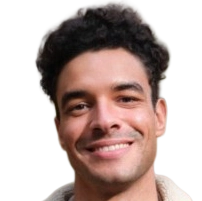
Vincent Pauline
→ Group Stefan Bauer
Algorithmic Machine Learning & Explainable AI
Vincent Pauline
→ Group Stefan Bauer
Algorithmic Machine Learning & Explainable AI
Recent News @MCML


Publications @MCML
2026

Flow-Based Density Ratio Estimation for Intractable Distributions with Applications in Genomics.
ICML 2026 - 43rd International Conference on Machine Learning. Seoul, South Korea, Jul 06-11, 2026. To be published. Preprint available. URL GitHub
From Growing to Looping: A Unified View of Iterative Computation in LLMs.
ICML 2026 - 43rd International Conference on Machine Learning. Seoul, South Korea, Jul 06-11, 2026. To be published. Preprint available. URL
Are Object-Centric Representations Better at Compositional Generalization?
ICML 2026 - 43rd International Conference on Machine Learning. Seoul, South Korea, Jul 06-11, 2026. To be published. Preprint available. URL
Amortised Inference through One-Step Implicit Sampling.
SPIGM @ICML 2026 - Workshop on Structured Probabilistic Inference and Generative Modeling at the 43rd International Conference on Machine Learning. Seoul, South Korea, Jul 06-11, 2026. URL
On Closed-Form Couplings.
GRaM @ICLR 2026 - Workshop on Geometry-grounded Representation Learning and Generative Modeling at the 14th International Conference on Learning Representations. Rio de Janeiro, Brazil, Apr 23-27, 2026. To be published. Preprint available. URL
DDNO: Discrete Diffusion Noise Optimization.
ReALM-GEN @ICLR 2026 - Workshop on Real‑World Constrained and Preference‑Aligned Flow‑ and Diffusion‑Based Models at the 14th International Conference on Learning Representations. Rio de Janeiro, Brazil, Apr 23-27, 2026. To be published. Preprint available. URL
Generative AI designs functional thiolation domains for reprogramming non-ribosomal peptide synthetases.
Preprint (Mar. 2026). DOI
2025
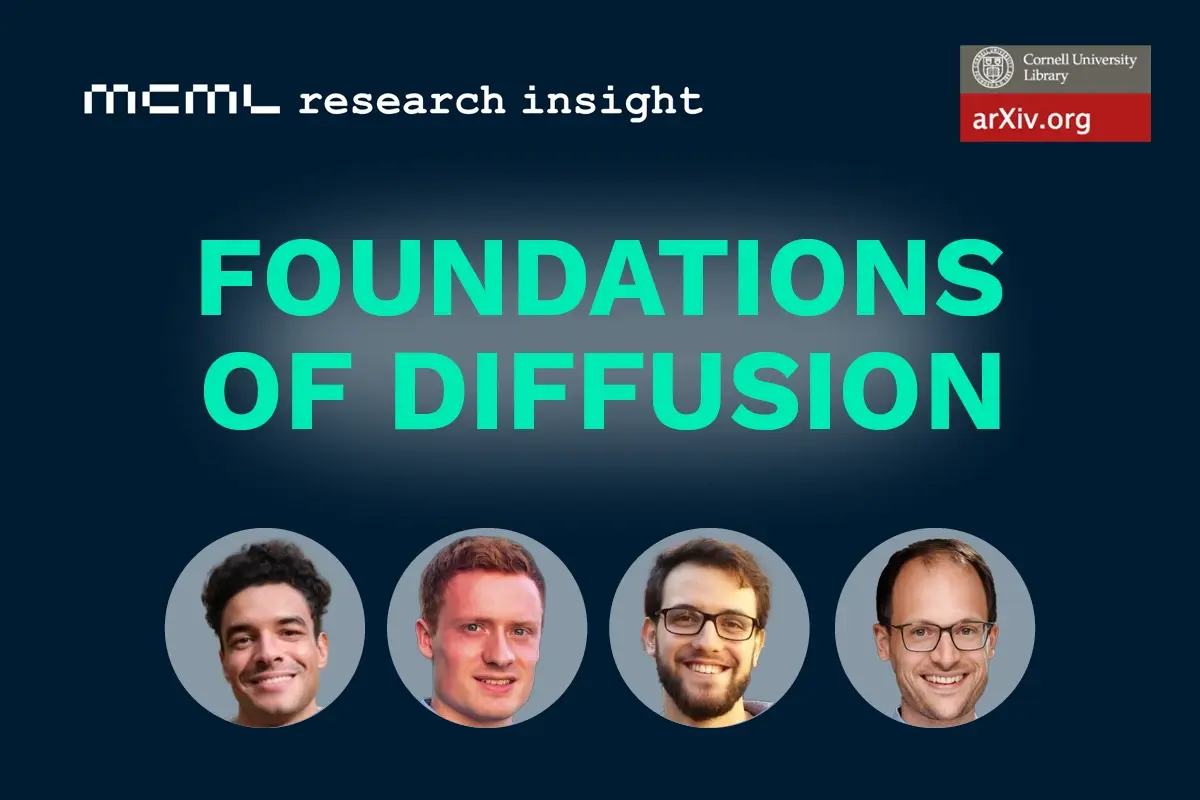
Foundations of Diffusion Models in General State Spaces: A Self-Contained Introduction.
Preprint (Dec. 2025). arXiv
When Does Closeness in Distribution Imply Representational Similarity? An Identifiability Perspective.
NeurIPS 2025 - 39th Conference on Neural Information Processing Systems. San Diego, CA, USA, Nov 30-Dec 07, 2025. URL
Does Data Scaling Lead to Visual Compositional Generalization?
ICML 2025 - 42nd International Conference on Machine Learning. Vancouver, Canada, Jul 13-19, 2025. URL GitHub
Panopticon: Advancing Any-Sensor Foundation Models for Earth Observation.
EARTHVISION @CVPR 2025 - Workshop EarthVision: Large Scale Computer Vision for Remote Sensing Imagery at the IEEE/CVF Conference on Computer Vision and Pattern Recognition. Nashville, TN, USA, Jun 11-15, 2025. Best Paper Award. DOI

Causal machine learning for single-cell genomics.
Nature Genetics 57.4. Apr. 2025. DOI
A scalable gene network model of regulatory dynamics in single cells.
Preprint (Mar. 2025). arXiv
Biases in machine-learning models of human single-cell data.
Nature Cell Biology 27.2. Feb. 2025. DOI
2024
Challenges in Explaining Representational Similarity through Identifiability.
UniReps @NeurIPS 2024 - 2nd Workshop on Unifying Representations in Neural Models at the 37th Conference on Neural Information Processing Systems. Vancouver, Canada, Dec 10-15, 2024. URL
Causal machine learning for predicting treatment outcomes.
Nature Medicine 30. Apr. 2024. DOI
©all images: LMU | TUM
2024-12-27 - Last modified: 2026-07-03