05.10.2026

©Astrid Eckert
How a Startup Is Making AI Faster and More Sustainable
Pruna AI Develops Optimized, Highly Efficient AI Models
The capabilities of artificial intelligence (AI) are growing rapidly; at the same time, energy consumption and costs are rising. This is where Pruna AI comes in: The startup develops highly efficient and cost-effective AI models. The goal is to keep AI accessible to researchers and businesses, particularly in Europe, and to significantly reduce its environmental footprint.
Especially in research, which relies on powerful computational models, the costs and energy consumption of AI have risen sharply in recent years. The Pruna AI team is therefore developing AI models that require significantly fewer resources while maintaining high performance.
In addition to research, typical use cases can be found in e-commerce, for example: A company wants to allow its customers to upload a photo to an app and virtually try on different items of clothing. For this “virtual try-on” to work in everyday life, the AI model must generate realistic images in fractions of a second - such as the same person wearing different T-shirts - while operating cost-effectively enough to allow the feature to be used millions of times.
How Pruna Makes AI Models More Efficient
Technically, the start-up relies on several compression and optimization methods that target different parts of the model. For example, connections and model components that play only a minor role in the result are removed. In addition, intermediate results that have already been calculated can be temporarily stored so they do not have to be recalculated for later, similar requests.
The technical distinction of Pruna AI’s methods lies in the fact that they are not used in isolation, but rather combined and applied to models in a standardized manner. The system then automatically evaluates the extent to which speed, memory usage, and quality change compared to the original model. This makes it possible to find the optimal balance between efficiency and accuracy for different applications. In addition, Pruna AI relies on agent-based methods to further improve the quality of the models.
Europe Must Remain Technologically Competitive
Pruna AI is backed by a four-person founding team: Bertrand Charpentier, Rayan Nait Mazi, John Rachwan, and TUM Professor Stephan Günnemann. The idea for the startup emerged around 2020 while Bertrand Charpentier was working on his doctoral dissertation and John Rachwan was working on his undergraduate research projects; during their research at TUM, they were directly confronted with the challenges of developing efficient and high-performance AI.
«We need to develop AI systems that can operate with significantly fewer resources. This is particularly crucial for Europe if we want to remain technologically competitive.»
Stephan Günnemann
MCML PI
“But there was also always the thought that relying on additional energy sources, such as nuclear power plants, to meet AI’s growing computational demands couldn’t be the right approach. Instead, we need to develop AI systems that can operate with significantly fewer resources. This is particularly crucial for Europe if we want to remain technologically competitive. That’s why, in addition to our location in Munich, we also have another one in Paris,” says Stephan Günnemann. The diverse and international team has since grown to 16 full-time employees and several student assistants.
The team received funding from the EXIST startup grant, as well as from UnternehmerTUM, the Center for Innovation and Entrepreneurship, and the TUM Venture Labs Software/AI and Robotics/AI.
©Astrid Eckert
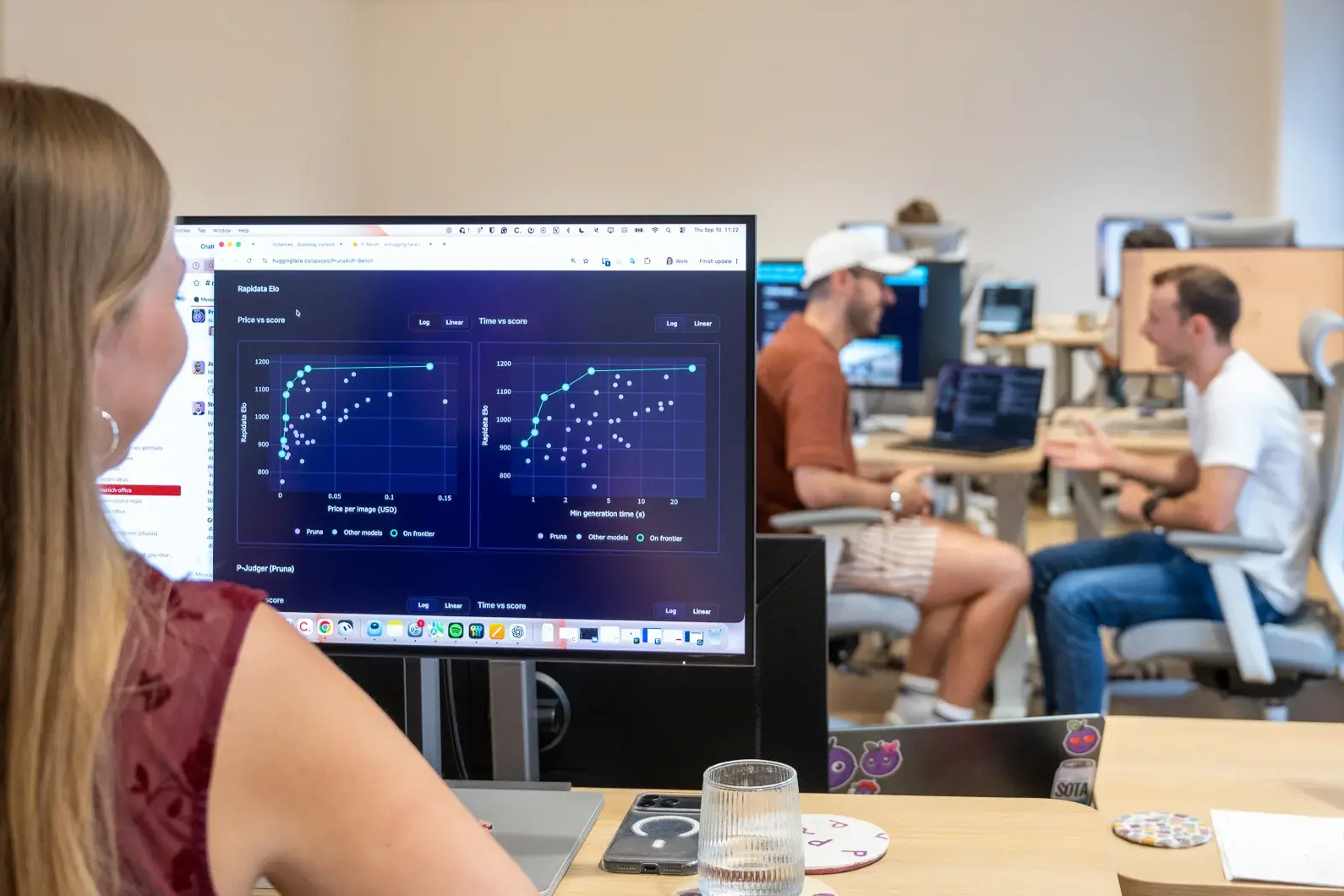
A Look Inside Pruna AI's Offices
Related


23.10.2026
MCML at EMNLP 2026
MCML researchers are represented with 47 papers at EMNLP 2026 (31 Main, 11 Findings, and 5 Workshops).

15.10.2026
When Flatter Is Not Always Better
In their ICML 2026 paper, MCML researchers show why the flattest regions found during neural network training are not always the best.