20.07.2026
©iStockphoto.com / Jacob Wackerhausen
TUM Develops Intelligent 3D Twins of Crime Scenes
Advancing AI for Digital Crime Scene Investigation
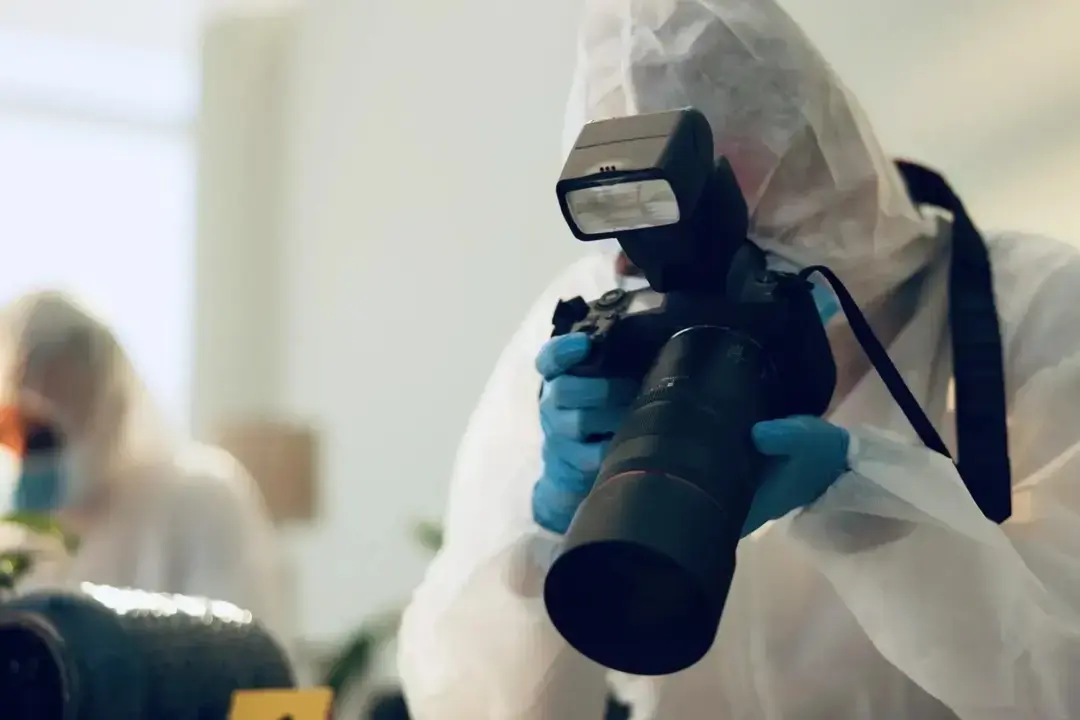
A crime scene is often accessible only for a short period of time. During that time, all relevant evidence must be documented quickly, and even small details can prove crucial. Researchers at the Technical University of Munich (TUM) and the Bavarian State Criminal Police Office (BLKA) are working together to fundamentally transform this process. Using artificial intelligence, investigators will be able to interact with virtual representations of crime scenes in the future.
The Bavarian State Criminal Police Office already uses 3D models of crime scenes today. Hundreds or even thousands of photographs are combined to create digital reconstructions that can support investigations long after evidence has been collected. In their joint research project, however, TUM and the BLKA are taking this concept a step further: the virtual crime scene should not only be viewed, but also queried.
“I am looking for a red jacket,” “How many knives are in the room?” or “Show me all sharp objects” – in the future, specialized AI software will be able to answer questions like these directly. To make this possible, the researchers are developing methods that automatically identify, classify, and catalogue objects within a digital crime scene. Objects of interest are highlighted in the model and can immediately be incorporated into investigative work.
From Individual Traces to a Comprehensive Digital Picture
“The long-term goal is to bring together many different types of evidence in a shared virtual environment and place them in relation to one another. This could make it significantly easier for investigators to understand connections between objects, locations, and possible sequences of events,” says Michael Greza, head of project and academic staff member at the Professorship for Photogrammetry and Remote Sensing at TUM.
The team has already developed a method that accelerates the creation of 3D crime scenes. Crime scene documentation often generates very large numbers of photographs. The new approach automatically identifies images that do not provide additional information, thereby reducing the effort required to process the data.
Researchers are currently working on functions that can analyze spatial relationships between objects. This will make it possible, for example, to perform line-of-sight calculations to examine whether people could see one another from specific positions or which areas of a room were visible.
Research and Practice Closely Intertwined
Researchers and criminal investigation experts jointly develop the methods and continuously adapt them to practical requirements. While TUM focuses primarily on fundamental AI and data analysis methods, the BLKA contributes expertise from criminal investigations and further develops the methods for specific operational scenarios.
“The research opens up entirely new possibilities in several areas. Although digital crime scene models and simulation methods already exist, many analyses still require considerable effort. The new technologies enable complex analyses directly within the virtual crime scene,” says MCML PI Benjamin Busam, Professor of Photogrammetry and Remote Sensing at TUM.
Perspective for Everyday Police Work
The methods developed so far will now be gradually integrated into the workflows of the Bavarian and Hessian State Criminal Police Offices. After developing methods for automatic object recognition in 3D crime scenes and for the efficient processing of large image datasets, the researchers are currently working on functions that analyze spatial relationships and lines of sight. In the long term, the technology is intended to make the use of digital crime scene twins much easier – potentially allowing patrol officers to capture data using smartphones directly at the scene.
Related



05.10.2026
Honorable Mention at GCPR 2026
A GCPR 2026 paper co-authored by MCML Director Daniel Cremers received an Honorable Mention at the conference in Siegen.

05.10.2026
Honorable Mention at GCPR 2026
A GCPR 2026 paper co-authored by MCML Director Daniel Cremers and MCML PI Riccardo Marin received an Honorable Mention.