30.04.2025
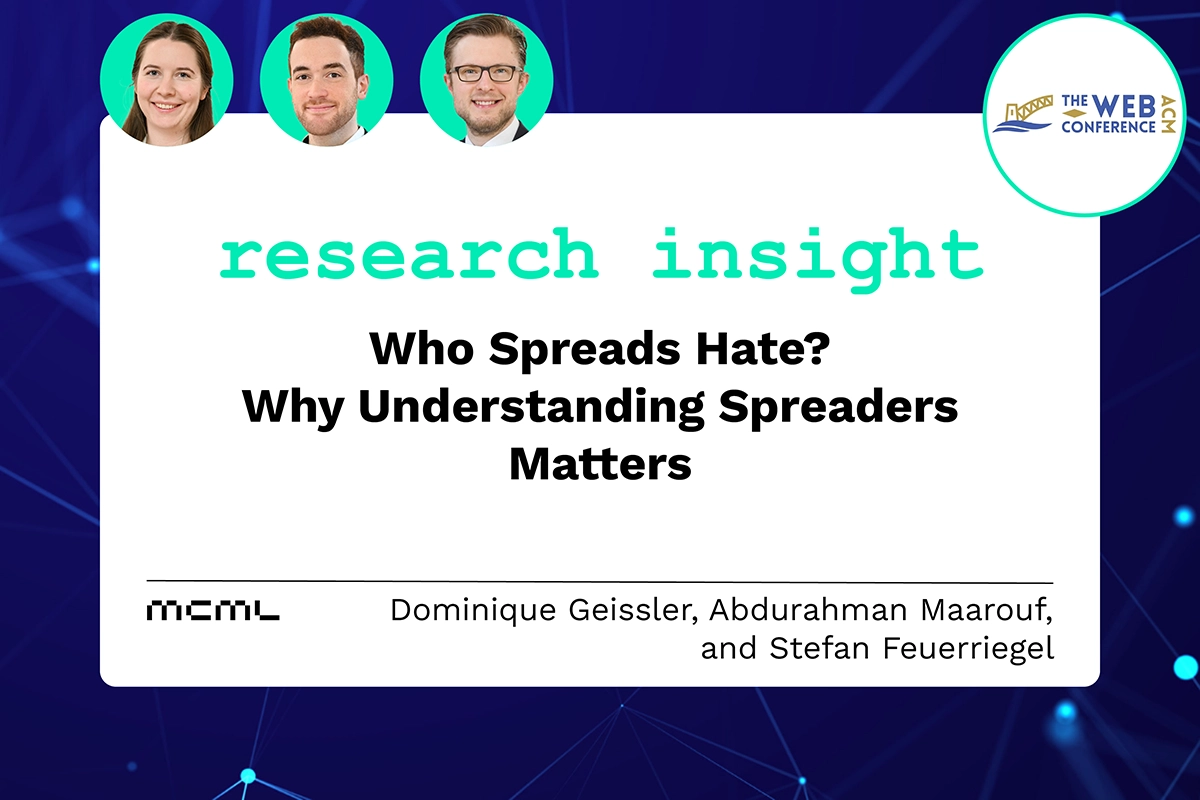
Who Spreads Hate?
MCML Research Insight – With Dominique Geissler, Abdurahman Maarouf, and Stefan Feuerriegel
Hate speech on social media isn’t just offensive - it’s dangerous. It spreads quickly, harms mental health, and can even contribute to real-world violence. While many studies have focused on identifying hate speech or profiling those who create it, a key piece of the puzzle remained missing: Who reshares hate speech?
The team at MCML - Dominique Geissler, Abdurahman Maarouf, and PI Stefan Feuerriegel - explored this question with their latest work: "Analyzing User Characteristics of Hate Speech Spreaders on Social Media".
Why Understanding Spreaders Matters
«Understanding the factors that drive users to share hate speech is crucial for detecting individuals at risk of engaging in harmful behavior and for designing effective mitigation strategies»
Dominique Geissler et al.
MCML Junior Members
Resharing on Social Media can propagate hate speech far beyond its origin. However, not much is known about the people who click the “share” button. To address this gap, the team developed a method to analyse resharing behaviour across different types of hate - such as political, racist, or misogynistic content.
Using large language models and debiasing techniques from causal inference, they were able to pinpoint which user characteristics correlate with hate speech resharing - without falling into the trap of biased social media data.
How the Model Works
The study follows a three-step strategy:
- Clustering Hate: First, hate speech posts are grouped by topic using BERTopic and labeled with LLAMA-3.
- Past Latent Vulnerability: Next, the model estimates how vulnerable a user is to hate content - how likely they are to see and engage with it - using reweighted, debiased click data.
- Modeling Behavior: Finally, the model uses an explainable boosting machine to predict which users are more likely to reshare hate, based on features like follower count, posting activity, and account age.
«We find that, all else equal, users with fewer followers, fewer friends, fewer posts, and older accounts share more hate speech.»
Dominique Geissler et al.
MCML Junior Members
Key Takeaways
- Low Influence, High Harm: Surprisingly, users with low social influence are the primary spreaders of most hate speech.
- Not All Hate Is the Same: Racist and misogynistic hate is spread mostly by users with little social influence. In contrast, political anti-Trump and anti-right-wing hate is reshared by users with larger social influence.
- Feature Spotlight: A feature importance analysis revealed that the number of posts was the strongest predictor of hate speech resharing, followed by the number of followers.
Why It Matters
Identifying hate speech is only half the battle. Understanding who spreads it opens the door for smarter moderation, better platform design, and more effective interventions.
Curious what the authors suggest to reduce the probability of resharing hate speech? Then read the full paper that will be presented at WWW 2025 - The A* ACM Web Conference in Sidney, one of the most prestigious venues in web and internet-related research.

Analyzing User Characteristics of Hate Speech Spreaders on Social Media.
WWW 2025 - ACM Web Conference. Sydney, Australia, Apr 28-May 02, 2025. DOI
Share Your Research!
Get in touch with us!
Are you an MCML Junior Member and interested in showcasing your research on our blog?
We’re happy to feature your work—get in touch with us to present your paper.
Related


05.10.2026
Honorable Mention at GCPR 2026
A GCPR 2026 paper co-authored by MCML Director Daniel Cremers received an Honorable Mention at the conference in Siegen.

05.10.2026
Honorable Mention at GCPR 2026
A GCPR 2026 paper co-authored by MCML Director Daniel Cremers and MCML PI Riccardo Marin received an Honorable Mention.